

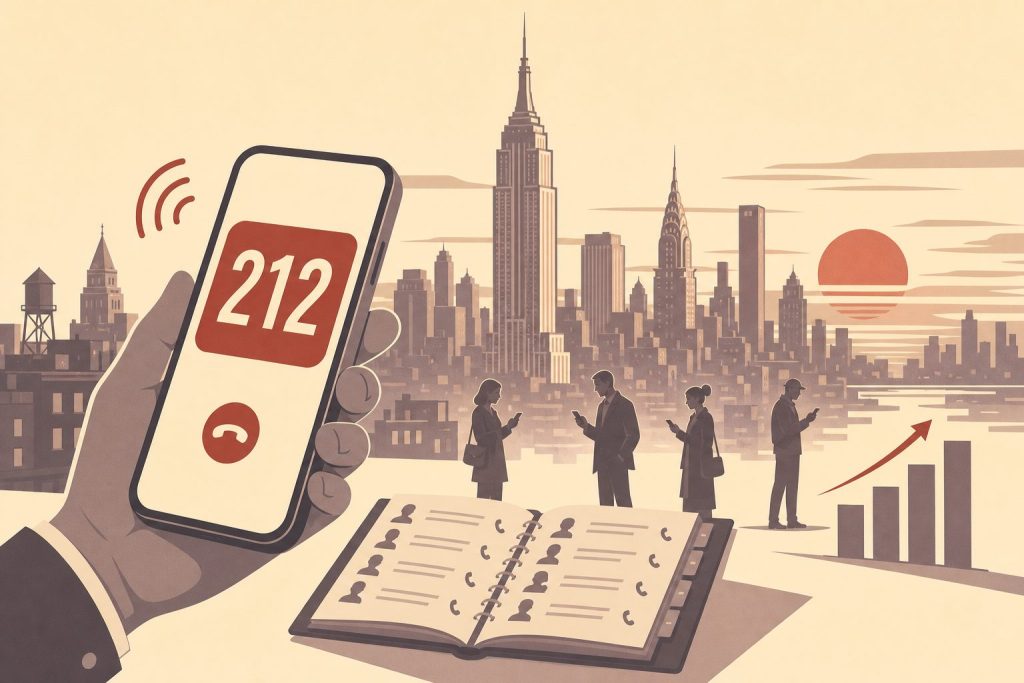
A 212 area code phone number is one of the few caller ID choices that lifts answer rates, signals instant credibility, and survives carrier spam filters — all before your agent says a word. This guide explains exactly why 212 outperforms every other option for outbound sales and telemarketing, and how to use it within today’s compliance rules.
Why Caller ID Is the First Battle in Every Outbound Campaign
Every outbound call begins with the same moment: a prospect glances at their screen and decides in under two seconds whether to pick up or decline. That decision is almost entirely driven by the caller ID display. Toll-free prefixes — 800, 888, 877 — have been so thoroughly associated with robocalls that most consumers let them roll to voicemail without a second thought. The problem extends beyond toll-free numbers: any unfamiliar out-of-state local number also underperforms, because the prospect cannot place it geographically and defaults to suspicion.
Local presence is the baseline; prestige local presence is the ceiling. A 212 area code phone number delivers both simultaneously. It is recognized nationwide as Manhattan — not as an anonymous call center, not as a robo-dialer farm, but as the business capital of the United States. That recognition changes how prospects engage before you say a single word.
Ready to Get a 212 Number?
One-time fee. No monthly charges. Port to any carrier in 3–5 business days. NYC's most trusted source since 2009.
Browse 212 Numbers →Industry research consistently bears this out. Local area codes generate answer rates roughly 20–40% higher than toll-free numbers on outbound campaigns. When the area code is associated with a market the prospect respects, the lift is even more pronounced. A 212 number hits both marks for any NYC-area prospect and carries aspirational weight for prospects anywhere in the country.
What Makes 212 Different From Every Other NYC Area Code
212 is not just any New York City area code. When the North American Numbering Plan launched on January 1, 1947, 212 was assigned to cover all five boroughs. Over the following decades, demand forced overlay codes — 917 in 1992, 646 in 1999, and 332 in 2017. Those codes cover the same geography but carry none of the legacy.
Today, 212 numbers are genuinely scarce. New assignments are limited, and the available pool is small. This is not a marketing talking point — it is an operational reality of the numbering system. Businesses that display a 212 number signal to every prospect that they are established, invested, and legitimate. You cannot simply sign up for a 212 the way you can grab a 646 or a 332. That exclusivity is part of the value.
Cultural reinforcement matters too. 212 has appeared in films, television, and popular culture for decades as shorthand for serious New York business — law firms on Park Avenue, financial institutions on Wall Street, media companies in Midtown. When your outbound calls display 212, you inherit that association whether you are calling a New York prospect or one in Dallas or Denver.
One telling proof point: bad actors specifically spoof 212 numbers in fraud schemes precisely because the answer rates are unusually high. The correct response is to acquire a legitimate, verified 212 number rather than trade on a spoofed one. Authentic 212 numbers pass STIR/SHAKEN carrier authentication checks; spoofed ones do not, and carriers increasingly block unauthenticated calls before they ever ring.
The Specific Telemarketing Benefits — Broken Down
Higher answer rates on the first attempt. Every additional callback attempt costs time, agent capacity, and money. When a 212 number prompts a prospect to pick up on the first ring rather than the third attempt — or never — the economics of your campaign improve directly. Lower cost per contact means more budget available for volume or follow-up sequences.
Reduced spam-flagging risk. Carrier analytics and third-party apps like Hiya and TNS flag numbers displaying behaviors associated with robocalls. A legitimate, durable 212 number used with reasonable call volume and proper STIR/SHAKEN certification is far less likely to be flagged than a newly provisioned VoIP number churned through a dialer. Number age and authentic registration history matter to carrier trust algorithms.
Instant brand credibility at the moment of contact. A 212 number primes prospects to treat the call as potentially worthwhile rather than immediately defensive. Your agents spend less time overcoming reflexive resistance and more time delivering their message.
Improved conversion rates on outbound-to-inbound follow-up. Research suggests 72% of consumers prefer calling businesses with local phone numbers when they decide to reach back out. If your 212 number appears on a missed calls list, a voicemail, or an email signature, prospects are meaningfully more likely to return the call than they would be for an 800 number or an unfamiliar out-of-state DID.
Local SEO benefit for Manhattan-facing businesses. Google’s local ranking algorithm considers whether a business’s listed phone number matches its claimed service area. A 212 number for a business serving Manhattan or the broader NYC market is a positive signal in the local pack.
Differentiation from competitors using generic DIDs. Most outbound call centers use whatever local presence numbers are cheapest and most available. When a 212 number appears on caller ID instead of a random 10-digit number from a VoIP pool, it stands out — and scarcity means most competitors cannot match it.
Using a 212 Number Responsibly — What You Need to Know
A 212 area code phone number amplifies the effectiveness of your outbound campaigns — but that amplification works in both directions. Here is a concise overview of the compliance framework that applies to outbound telemarketing in 2025 and 2026.
The two primary federal frameworks are the FCC’s Telephone Consumer Protection Act (TCPA) and the FTC’s Telemarketing Sales Rule (TSR). Calling hours are restricted to 8:00 AM–9:00 PM in the recipient’s local time zone at the federal level; several states, including Florida, impose tighter windows. New York State requires telemarketers to offer an opt-out opportunity within three seconds of the call beginning — directly relevant if you are using a 212 number to reach NYC-area prospects.
The National Do Not Call Registry now holds over 258 million active numbers. Lists must be scrubbed no more than 31 days before any campaign begins. As of January 27, 2025, the FCC’s one-to-one consent rule requires that autodialed calls and robocalls be tied to consent given specifically to your company — the lead-generator loophole of bundling consent across dozens of sellers is closed. Revocation of consent must be honored within 10 business days. TCPA violations carry penalties of $500 per negligent violation and $1,500 per willful violation, with class-action exposure running into the millions. Consult the FTC’s TSR resource page and your legal counsel for full guidance.
A legitimate, authenticated 212 number used within compliant calling practices is a genuine competitive asset. That same number used to amplify non-compliant volume compounds fines and legal exposure. Use the power of 212 as a reason to run better, more targeted campaigns — not higher raw volume against unqualified lists.
Frequently Asked Questions
Does a 212 area code number work for outbound calling outside of New York?
Yes — and this is one of its most underappreciated advantages. Because 212 is nationally recognized as a Manhattan area code, prospects across the country associate it with credible, established business rather than an unfamiliar local number from an area code they cannot place. For businesses targeting clients who respect NYC-based firms — finance, media, legal, real estate, technology — the 212 area code carries weight in every market.
Is it legal to use a 212 number for telemarketing if my business is not physically located in Manhattan?
Yes. There is no FCC or FTC requirement that a business be physically located in an area code’s geographic region to use that area code as its outbound calling number. The FCC does require that the caller ID number be valid and callable — one your business actually controls and that rings back to you. A 212 number you legitimately own satisfies that requirement regardless of your physical location.
What is STIR/SHAKEN and why does it matter for my 212 number?
STIR/SHAKEN is the FCC-mandated call authentication framework carriers use to verify whether an outbound call’s caller ID matches the registered owner of that number. Calls that pass are labeled “Verified” on compatible devices; calls that fail are labeled “Spam Risk” or blocked outright. A 212 number you legitimately own will pass STIR/SHAKEN attestation; a spoofed or unregistered 212 number will not.
How does a 212 number compare to a toll-free number for outbound sales campaigns?
Toll-free numbers consistently underperform local numbers on outbound campaigns — the answer-rate disadvantage runs 20–40% on average. Toll-free prefixes have become so associated with robo-dialers in consumer perception that many people avoid them reflexively. A 212 number reads as a business call, not a marketing blast.
Can I use a 212 number with my existing CRM or dialer platform?
In most cases, yes. A 212 number from a legitimate provider can typically be ported or provisioned as a SIP DID and integrated with major CRM and auto-dialer platforms. See our guides on using a 212 number with RingCentral and 212 number with Vonage for platform-specific details.
How scarce are 212 numbers, and does that affect availability?
212 is one of the most restricted area codes in North America. Overlays (917, 646, 332) absorbed new number demand over decades, leaving the 212 pool very limited. Numbers do come available periodically — through carriers releasing unassigned blocks or through the secondary market — but inventory is genuinely constrained. Acting when a number is available matters more with 212 than with most area codes.
What price should I expect for a 212 area code number?
Pricing reflects the scarcity and prestige of the code. Numbers in our inventory start from $150. Browse current inventory to see what is available — stock changes regularly.
Ready to put a 212 number to work in your next campaign? Call (212) 580-2000 or browse current inventory to find the right number for your business.
