

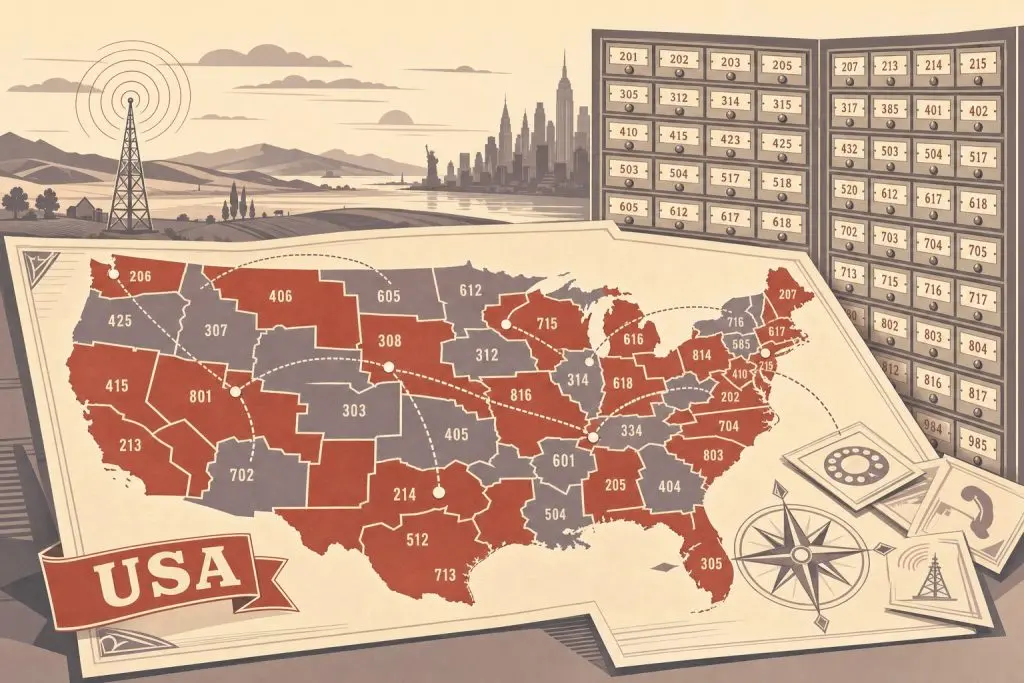
The United States has 335 area codes in total — 317 tied to geographic regions and 18 reserved for non-geographic uses like toll-free and premium services. This guide breaks down where that number comes from, how the North American Numbering Plan organizes it, why the count keeps growing, and how the US compares to the other 24 countries that share the +1 calling code.
The Short Answer: 335 Area Codes
The United States has 317 geographic area codes assigned to specific states, regions, and metropolitan areas, plus 18 non-geographic area codes reserved for special-purpose services. Added together, that brings the US total to 335 area codes currently in active use.
Geographic area codes are the ones most people think of first — 212 for Manhattan, 310 for west Los Angeles, 415 for San Francisco. Non-geographic codes serve different functions: 800, 888, 877, 866, 855, 844, and 833 are the seven toll-free codes that route calls anywhere in the country regardless of where they originate. Others like 900 (premium-rate services) and 500-series codes (personal communications services) round out the non-geographic group.
The total isn’t fixed — new area codes are added regularly as existing ones run out of available phone numbers, and the count has roughly doubled over the last 30 years. The North American Numbering Plan Administrator (NANPA) publishes the current count, and the figures cited here reflect the active inventory as of 2026.
How the North American Numbering Plan Works
Every phone number in the US, Canada, and 23 other participating countries operates under the North American Numbering Plan, or NANP. Created in 1947 by AT&T to standardize call routing across North America, the plan was originally administered by Bell. Today the FCC oversees it in the US, with NANPA — a neutral third-party administrator — handling day-to-day assignments.
Ready to Get a 212 Number?
One-time fee. No monthly charges. Port to any carrier in 3–5 business days. NYC's most trusted source since 2009.
Browse 212 Numbers →What most people call an “area code” has an official designation: Number Plan Area, or NPA. Every NANP phone number follows the same format: a three-digit NPA (the area code), a three-digit central office code (also called an NXX), and a four-digit line number. The familiar 10-digit US phone number is really NPA-NXX-XXXX.
All NANP countries share the +1 country calling code, which is why dialing internationally to any of them starts with the same prefix. The 25 participating countries include the United States, Canada, and most of the English-speaking Caribbean — Jamaica, the Bahamas, Barbados, Trinidad and Tobago, the Dominican Republic, and others. Together they share a pool of around 800 possible area codes, though only a fraction are currently assigned.
Geographic vs. Non-Geographic Area Codes
The 317 geographic area codes are tied to physical locations. When the NANP was first published in 1947, the entire United States had just 86 area codes — California had three, New York had five, and large rural states often had just one. As population grew and phone use exploded, new codes were added through two mechanisms: splits (the old area code is divided into two new regions) and overlays (a new code is layered on top of the existing region, with all local calls becoming 10-digit).
Overlays are now the dominant relief method because they don’t force existing customers to change their numbers. Manhattan is a familiar example: the original 212 was joined by 646 in 1999 and 332 in 2017, all serving the same geographic footprint. Anyone living or working in Manhattan today might have any of the three.
The 18 non-geographic codes serve specific purposes:
Toll-free codes — 800, 888, 877, 866, 855, 844, and 833 — let the called party pay for the call instead of the caller. They’re used heavily by businesses for customer service lines. A new toll-free code is added to the pool whenever the previous one runs out; 822 is reserved for future activation.
Premium-rate codes — 900 is the most familiar — charge the caller a higher per-minute rate, with the called party receiving a share of the revenue.
Personal communications services codes — 500, 521, 522, 533, 544, 566, 577, 588 — were created for find-me/follow-me services that route to a person rather than a place. Adoption has been limited, and most of these codes remain lightly used.
Three special codes round out the non-geographic group: 710 is reserved for US government use, and 600 and 700 serve various interexchange carrier functions.
How Area Codes Get Assigned
NANPA doesn’t pick area codes arbitrarily. Each new geographic code is assigned to a state or region based on projected number exhaustion — the point at which existing area codes can no longer absorb new phone number requests at their current rate. State public utility commissions work with NANPA to determine when relief is needed and which form (split or overlay) to use.
Within a state, the choice of digits isn’t random either. Codes are pulled from the available NANP pool, which excludes certain reserved patterns. The middle digit historically had to be 0 or 1, which is why early codes follow the N0X/N1X pattern (212, 213, 312, 415, etc.). That restriction was lifted in 1995, opening up codes like 332, 657, and 929 — patterns that wouldn’t have been possible under the original numbering scheme.
If you’re curious about the full mechanics, our guide to how area codes are assigned walks through the process in detail.
How the US Compares to the Rest of NANP
The United States holds the majority of NANP area codes — 335 of roughly 380 currently assigned across all 25 NANP countries. Canada is the second-largest holder with 42 area codes, 40 of which are geographic and 2 non-geographic. The remaining codes are distributed across the Caribbean and US territories.
The disparity reflects population and phone density. The US has more than 330 million people and a long history of multiple phones per household and per person. Canada’s 40 million population uses fewer codes proportionally, and most Caribbean NANP members get by with a single area code each — 876 for Jamaica, 242 for the Bahamas, 246 for Barbados.
Because the +1 prefix is shared, calls between NANP countries dial like domestic long-distance calls rather than international ones. The downside is that a +1 number alone doesn’t tell you which country it’s from — only the area code does that, and it takes familiarity (or a quick lookup) to know that 868 means Trinidad and 809 means the Dominican Republic.
Which US States Have the Most Area Codes
Population drives area code count, but geography and growth patterns matter too. California leads by a wide margin with more than 35 area codes — the result of decades of growth across Los Angeles, the Bay Area, San Diego, and the Central Valley. Texas, Florida, and New York round out the top of the list, each with more than a dozen area codes each.
For state-by-state breakdowns, see our guides to how many area codes are in California, how many area codes are in Texas, and how many area codes are in Florida. New York City alone has six active area codes — 212, 646, 332, 718, 347, and 929 — plus the newer 465 code activated as the most recent Manhattan overlay.
At the other end of the spectrum, several states get by with a single area code: Alaska (907), Delaware (302), Hawaii (808), Maine (207), Montana (406), New Hampshire (603), North Dakota (701), Rhode Island (401), South Dakota (605), Vermont (802), West Virginia (304), and Wyoming (307). Most of these are low-population states where current numbering capacity has not been exhausted.
Why the Count Keeps Growing
Each area code contains roughly 7.92 million possible phone numbers in theory — 792 valid central office codes (NXX combinations) multiplied by 10,000 line numbers each. In practice the usable count is lower because blocks of numbers are reserved, withheld, or assigned in bulk to carriers who may never fully use them.
The shift to mobile phones is the single biggest driver of area code growth. A household that once shared a single landline now has multiple mobile lines, plus VoIP numbers for home offices, fax-replacement services, and second-line apps. Each of those consumes a number. The result is sustained pressure on the numbering pool, especially in dense urban areas.
NANPA has been preparing for the day the original NANP format runs out of new area codes entirely. Long-term plans exist for expanding the numbering plan format itself if that ever becomes necessary, but with hundreds of unassigned codes still in the pool, that exhaustion remains many years away.
Frequently Asked Questions
How many area codes are in the US in 2026?
The United States currently has 335 area codes — 317 geographic codes tied to specific regions and 18 non-geographic codes for toll-free, premium-rate, and special services.
How many area codes are there in total across NANP countries?
About 380 area codes are currently assigned across the 25 countries in the North American Numbering Plan. The US holds the majority at 335, Canada has 42, and the remainder are distributed across the Caribbean and US territories.
What’s the difference between a geographic and non-geographic area code?
Geographic area codes are tied to a specific state, region, or metro area — 212 for Manhattan, 415 for San Francisco. Non-geographic codes route to a service rather than a place. Toll-free codes (800, 888, 877, 866, 855, 844, 833) and premium-rate codes (900) are the most common examples.
Why do so many countries share the +1 country calling code?
Twenty-five countries — the US, Canada, and most of the English-speaking Caribbean — operate under the North American Numbering Plan, which uses +1 as the shared country code. The plan was created in 1947 to standardize call routing across the region, and member countries have remained on it ever since.
How are new area codes created when an old one runs out?
State public utility commissions work with NANPA to add relief through either a split (the existing region is divided in two, with half the customers getting a new code) or an overlay (a new code is layered on top of the existing region, and all calls become 10-digit). Overlays are now the standard because they don’t force any existing customers to change their numbers. See our guide on how area codes are assigned for the full process.
Which state has the most area codes?
California has the most, with more than 35 area codes spread across its major metro areas. Texas, Florida, and New York are next, each with more than a dozen. Our state ranking breaks down the full list.
Can an area code be retired?
In theory yes, but in practice it’s rare. Once a geographic code is in service, retiring it would force every customer in that region to change their phone number — a logistical nightmare that no state utility commission wants to authorize. Non-geographic codes are occasionally reassigned to new uses, but active geographic codes effectively stay in service indefinitely.
What’s the most prestigious US area code?
Manhattan’s 212 area code is widely considered the most prestigious in the country, both for its association with New York City’s status as a financial and cultural capital and because the original 212 numbering pool has been functionally exhausted since the 1980s. Genuine 212 numbers are now a finite resource, which is why they carry the value they do.
Ready to Get a Manhattan 212 Number?
If you want a piece of the most recognizable area code in the United States, every number on our shop is a genuine, portable 212 number — not a virtual forward or a number from a newer Manhattan overlay. Pricing starts From $150 depending on the digit pattern and memorability.
Browse current inventory to see what’s available right now, or call us at (212) 580-2000 if you’d like help choosing a number.
