

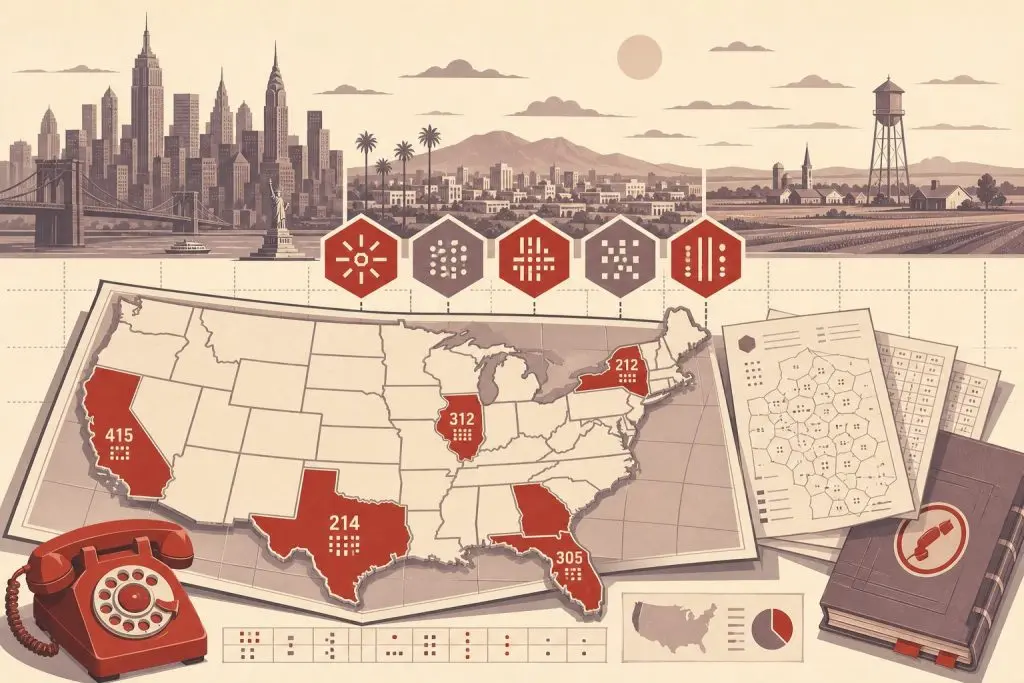
California, Texas, and New York lead the U.S. in active area codes — a reflection of population, business density, and how fast the supply of available phone numbers gets used up. This guide ranks the ten states with the most area codes, lists every code in each one, and explains why these states keep adding new ones.
Area codes were introduced in 1947 as part of the North American Numbering Plan to make long-distance dialing possible without an operator. The United States now has well over 300 geographic area codes in active use, and the number keeps growing — when a state’s existing codes run low on available phone numbers, regulators assign a new one through an overlay or a geographic split.
How a State Ends Up With Many Area Codes
An area code is a finite pool. Each one holds about 7.9 million possible seven-digit numbers, but real-world allocation, blocked prefixes, and carrier reservations mean the usable supply is smaller. When a region exhausts its pool, the North American Numbering Plan Administrator (NANPA) introduces a new code in one of two ways.
The first is a geographic split, where the existing region is cut in half and one half keeps the old code while the other gets a new one. Splits used to be common but are rare today because forcing millions of people to change their numbers is politically painful.
The second, and now standard, approach is an overlay. The new code is layered on top of the existing region, both codes coexist, and new numbers issued in that region can come from either code. Mandatory ten-digit dialing usually follows. Manhattan’s 212 area code, for example, is now overlaid with 332 and 646, and all three serve the same geographic footprint. The same dynamic plays out at scale in California, Texas, and Florida.
Ready to Get a 212 Number?
One-time fee. No monthly charges. Port to any carrier in 3–5 business days. NYC's most trusted source since 2009.
Browse 212 Numbers →California
California has 38 area codes: 209, 213, 279, 310, 323, 341, 408, 415, 424, 442, 510, 530, 559, 562, 619, 626, 628, 650, 657, 661, 669, 707, 714, 738, 747, 760, 805, 818, 820, 831, 840, 858, 909, 916, 925, 949, 951.
California’s combination of population, tech-industry density, and a sprawling geography across major metros (Los Angeles, San Francisco Bay, San Diego, Sacramento, Fresno) has made it the most area-code-heavy state in the country by a wide margin.
Texas
Texas has 28 area codes: 210, 214, 254, 281, 325, 346, 361, 409, 430, 432, 469, 512, 682, 713, 726, 737, 806, 817, 830, 832, 903, 915, 936, 940, 956, 972, 979.
The four major metros — Houston, Dallas-Fort Worth, San Antonio, and Austin — each pull multiple overlays, and Texas’s rapid population growth keeps the demand for new numbers high.
New York
New York has 21 area codes: 212, 315, 329, 332, 347, 363, 516, 518, 585, 607, 631, 646, 680, 716, 718, 838, 845, 914, 917, 929, 934.
New York City alone uses eight of those — 212, 332, 347, 646, 718, 917, 929, and 718’s overlays — and the new 465 code was recently announced as the next NYC overlay.
Florida
Florida has 21 area codes: 239, 305, 321, 352, 386, 407, 448, 561, 645, 656, 727, 728, 754, 772, 786, 813, 850, 863, 904, 941, 954.
Florida’s growth since the early 2000s has driven a steady run of overlays — Miami-Dade has 305 and 786, Broward has 754 and 954, and Tampa Bay has 813 and 727 plus the newer 656 and 728. See our breakdown of Florida area codes for the full city-by-city map.
Ohio
Ohio has 15 area codes: 216, 220, 234, 283, 326, 330, 380, 419, 440, 513, 567, 614, 740, 937, 984.
Cleveland, Columbus, Cincinnati, and Toledo each anchor multiple overlays, which is unusual for a state Ohio’s size and reflects how heavily the major metros have grown phone-number demand.
Illinois
Illinois has 14 area codes: 217, 224, 309, 312, 331, 447, 464, 618, 630, 708, 730, 773, 779, 815, 847, 872.
The Chicago metro carries most of the load — 312 covers the Loop, while 773, 872, 224, 331, 630, 708, 847, and the newer 464 cover the surrounding city and suburbs.
Pennsylvania
Pennsylvania has 13 area codes: 215, 267, 272, 412, 445, 484, 570, 582, 610, 717, 724, 814, 878.
Philadelphia and Pittsburgh both have overlays (215/267/445 and 412/878 respectively), and the rest of the state is divided among regional codes.
Michigan
Michigan has 12 area codes: 231, 248, 269, 278, 313, 517, 586, 616, 734, 810, 906, 989.
Detroit and its suburbs use 313, 248, 586, and 734 — the Upper Peninsula gets its own 906 because of geography rather than population.
Georgia
Georgia has 10 area codes: 229, 404, 470, 478, 678, 706, 762, 770, 912, 943.
The Atlanta metro accounts for five of them (404, 470, 678, 770, 943), a stack that grew quickly as Atlanta became one of the fastest-growing US cities of the last two decades.
New Jersey
New Jersey has 10 area codes: 201, 551, 609, 640, 732, 848, 856, 862, 908, 973.
For a relatively small state, that’s a lot — driven by the density of the northern half of the state and its commuter ties to New York City and Philadelphia.
How These States Compare
The pattern is consistent. The states with the most area codes are the states with the largest populations and the densest metros: California, Texas, New York, and Florida lead the list, and they’re also the four most populous states in the country. After that, the ranking tracks closely with metro-area concentration — Ohio, Illinois, Pennsylvania, Michigan, Georgia, and New Jersey all have multiple large cities or one very large one driving up demand.
The states with the fewest area codes are exactly what you’d expect: low-population states like Wyoming, Vermont, Alaska, and Delaware each operate on a single code, because their entire population fits comfortably inside one pool of seven-digit numbers.
Frequently Asked Questions
What state has the most area codes?
California has the most, with 38 active area codes. It’s been at the top of the list for decades thanks to its combination of high population, dense metro areas around Los Angeles and the San Francisco Bay, and steady growth in the tech and entertainment sectors.
Which state added an area code most recently?
New overlays are introduced every year somewhere in the country. New York City announced the new 465 area code as the next overlay for Manhattan, joining 212, 332, and 646. California, Texas, and Florida all see new overlays roughly every two to three years.
Why do some states have only one area code?
Each area code can support roughly 7.9 million phone numbers. States with populations well under that ceiling — Wyoming, Vermont, Alaska, Delaware, Montana, the Dakotas, Maine, New Hampshire — can serve all their residents and businesses from a single code without exhausting the supply.
How does a state get a new area code?
The North American Numbering Plan Administrator monitors number exhaustion in each region. When usable numbers in a region drop below a defined threshold, regulators authorize a new code as either an overlay (added on top of the existing region) or a split (which carves the region in two). Overlays are now standard because they don’t force anyone to change their existing number.
Why does California have so many area codes compared to states with similar populations?
Population is part of it, but density and business concentration matter more. The Los Angeles metro alone uses about a dozen codes because of the number of phone lines per square mile. Heavy commercial use, multiple media and tech industries, and high mobile-line counts all consume numbers faster than residential demand alone would.
Does having more area codes affect call quality or routing?
No. Area codes are routing labels, not capacity constraints. Whether you live in a state with 1 area code or 38, your calls connect through the same national network in the same way. The only practical difference is that areas with overlays require ten-digit dialing for local calls.
Can I get a phone number with an area code from any state?
Yes. Modern wireless and VoIP services let you choose a phone number based on the area code you want, regardless of where you physically live. A Manhattan 212 number, for example, can ring on a cell phone anywhere in the country.
Ready to Get a 212 Number?
If a New York City area code is the one you’re after, browse current inventory — numbers start From $150. Call us at (212) 580-2000 if you’d like help choosing a number or have questions about getting one set up on your carrier.
