
California has 41 active area codes as of 2026, covering the state through a mix of original 1947 assignments, geographic splits, and modern overlays. This guide walks through the full list, which regions each code serves, the order they came online, and where new codes are most likely to land next.
The Short Answer
California currently has 41 active area codes in service. The count reflects a combination of population growth, the rise of mobile lines, and the way modern numbering allocates blocks — every line activated, whether a cellphone, a business desk line, a VoIP number, or a connected device, consumes a slot in the pool.
By population, California ranks #1 nationally with roughly 39,431,263 residents as of the most recent estimates. That puts the state’s area code count in line with its population peers — denser, faster-growing states need more codes; smaller states need fewer.
The Full List of California Area Codes
The active area codes serving California are listed below, in numerical order. Where a code is an overlay or a split-off from an earlier code, that relationship is noted.
- 209 — Northern San Joaquin Valley (Stockton, Modesto, Merced, Turlock)
- 213 — Central Los Angeles and inner suburbs
- 279 — Sacramento metro (overlay of 916)
- 310 — Western and southwestern Los Angeles County (Westside, South Bay)
- 323 — Central Los Angeles and inner suburbs (split from 213)
- 341 — Western Alameda and Contra Costa counties (Oakland area) (overlay of 510)
- 350 — Northern San Joaquin Valley (Stockton, Modesto) (overlay of 209)
- 357 — Central San Joaquin Valley (Fresno, Visalia) (overlay of 559)
- 369 — Northwestern California and northern San Francisco Bay Area (overlay of 707)
- 408 — Most of Santa Clara County (San Jose, Sunnyvale)
- 415 — San Francisco and most of Marin County
- 424 — Western and southwestern Los Angeles County (overlay of 310)
- 442 — Southeastern and southernmost California (desert and far-south regions) (overlay of 760)
- 510 — Western Alameda and Contra Costa counties (Oakland, Berkeley, Fremont)
- 530 — Northeastern California (Redding, Chico, Davis)
- 559 — Central San Joaquin Valley (Fresno, Visalia, Madera) (split from 209)
- 562 — Southeastern Los Angeles County (Long Beach, Whittier, Norwalk) (split from 310)
- 619 — City of San Diego and suburbs
- 626 — San Gabriel Valley (Pasadena, El Monte, West Covina) (split from 818)
- 628 — San Francisco and most of Marin County (overlay of 415)
- 650 — San Mateo County and northern Santa Clara County (Palo Alto, Redwood City) (split from 415)
- 657 — Orange County (Anaheim, Santa Ana, Huntington Beach) (overlay of 714)
- 661 — Kern County and northern Los Angeles County (Bakersfield, Santa Clarita) (split from 805)
- 669 — Most of Santa Clara County (San Jose, Sunnyvale) (overlay of 408)
- 707 — Northwestern California and northern San Francisco Bay Area (Santa Rosa, Napa, Vallejo, Eureka)
- 714 — Northern Orange County (Anaheim, Santa Ana, Huntington Beach)
- 738 — Central Los Angeles and inner suburbs (overlay of 213 and 323)
- 747 — San Fernando Valley (Burbank, Van Nuys, Glendale) (overlay of 818)
- 760 — Southeastern and far-south California (Palm Springs, Oceanside, Barstow, El Centro)
- 805 — Central Coast (Santa Barbara, San Luis Obispo, Ventura, Oxnard)
- 818 — San Fernando Valley (Burbank, Van Nuys, Glendale)
- 820 — Central Coast (Santa Barbara, San Luis Obispo, Ventura) (overlay of 805)
- 831 — Northern Central Coast (Monterey, Santa Cruz, Salinas) (split from 408)
- 837 — Northeastern California (Redding, Chico, Davis) (overlay of 530)
- 840 — Eastern Los Angeles County and southwestern San Bernardino County (overlay of 909)
- 858 — City of San Diego and suburbs (split from 619)
- 909 — Eastern Los Angeles County and southwestern San Bernardino County (San Bernardino, Ontario, Pomona)
- 916 — Sacramento and most of the Sacramento metro (Folsom, Roseville)
- 925 — Eastern Contra Costa and Alameda counties (Concord, Walnut Creek, Livermore) (split from 510)
- 949 — Southern Orange County (Irvine, Newport Beach, San Clemente) (split from 714)
- 951 — Western Riverside County (Riverside, Corona, Moreno Valley, Temecula) (split from 909)
How California’s Area Codes Grew Over Time
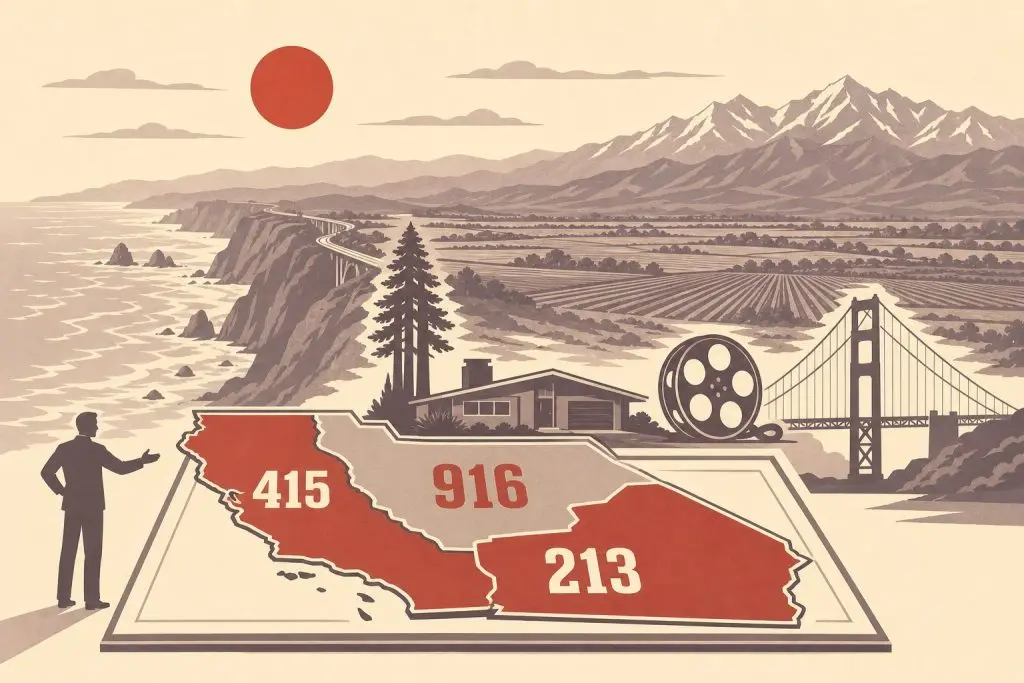
California was assigned 3 area codes in the original 1947 NANP launch — 213, 415, 916 — reflecting the state’s population and territorial size at the time. Subsequent splits and overlays have added codes as demand has grown.
Ready to Get a California Number?
One-time fee. No monthly charges. Port to any carrier in 3–5 business days. NYC's most trusted source since 2009.
Browse California Area Codes →- 1947 — California received three of the original North American area codes at the launch of the numbering plan: 213 for the south, 415 for the central region, and 916 for the north.
- 1950 — California's numbering plan areas were redrawn, with 415 becoming the coastal region and 916 the northeastern corner; Sacramento moved from 415 to 916 and Bakersfield moved to 213.
- 1951 — 714 split off from 213 to serve much of southern California outside Los Angeles, including Orange County and San Diego.
- 1957 — 805 split off from 213 on January 1 for the Central Coast and surrounding region.
- 1958 — 209 split off from 916 for the northern San Joaquin Valley (Stockton, Modesto, Fresno).
- 1959 — 408 split off from 415 on January 1 for the South Bay and Santa Clara County, and 707 split off from 916 on March 1 for the North Coast and northern Bay Area.
- 1982 — 619 split off from 714 on November 5 for San Diego and the far-south region.
- 1984 — 818 split off from 213 on January 7 for the San Fernando Valley and San Gabriel Valley.
- 1991 — 310 split off from 213 on November 2 for western Los Angeles County, and 510 split off from 415 on September 2 for the East Bay.
- 1992 — 909 split off from 714 on November 14 for the Inland Empire (San Bernardino and Riverside counties).
- 1997 — Five new codes activated: 562 (split from 310, January 25), 760 (split from 619, March 22), 626 (split from 818, June 14), 650 (split from 415, August 2), and 530 (split from 916, November 1). The 323 split from 213 also took effect this year.
- 1998 — Four new codes activated: 925 (split from 510, March 14), 949 (split from 714, April 18), 831 (split from 408, July 11), and 559 (split from 209, November 14).
- 1999 — 661 split off from 805 on February 13 for Kern County and northern Los Angeles County, and 858 split off from 619 on June 12 for northern San Diego.
- 2004 — 951 split off from 909 on July 17 for western Riverside County.
- 2006 — 424 activated on August 26 as an overlay of 310 in western Los Angeles County.
- 2008 — 657 activated on September 23 as an overlay of 714 in Orange County.
- 2009 — 747 activated on May 18 as an overlay of 818 in the San Fernando Valley, and 442 activated on October 24 as an overlay of 760.
- 2012 — 669 activated on November 20 as an overlay of 408 in Santa Clara County.
- 2015 — 628 activated on March 21 as an overlay of 415 in San Francisco and Marin County.
- 2018 — 279 activated on March 10 as an overlay of 916 in the Sacramento metro, and 820 activated on July 2 as an overlay of 805 on the Central Coast.
- 2019 — 341 activated on July 22 as an overlay of 510 in the East Bay.
- 2021 — 840 activated on February 23 as an overlay of 909 in the Inland Empire.
- 2022 — 350 activated on November 28 as an overlay of 209 in the northern San Joaquin Valley.
- 2023 — 369 activated on February 1 as an overlay of 707 in northwestern California and the northern Bay Area.
- 2024 — 738 activated on November 1 as an overlay of 213 and 323 in central Los Angeles.
- 2025 — 837 activated on January 31 as an overlay of 530, and 357 activated on March 26 as an overlay of 559 in the central San Joaquin Valley.
Why California Needs So Many Area Codes
A single area code can hold roughly 7.9 million possible phone numbers in theory — 792 valid central office codes (the second three digits) multiplied by 10,000 line numbers each. In practice the usable count is lower, because blocks of numbers are reserved, withheld, or assigned in bulk to carriers that may never fully use them. When the pool of available numbers in an area code falls below the threshold the North American Numbering Plan Administrator (NANPA) tracks, the state requests relief, and either a split or an overlay is approved.
California’s population of roughly 39,431,263 residents would, on its own, fit comfortably inside a single area code’s capacity. The reason 41 codes are needed instead is that every adult typically carries at least one mobile line, many households have multiple lines per person, businesses concentrate phone numbers at extreme density, and connected devices, VoIP services, and second-line apps all draw from the same pool. The math compounds quickly.
Because California sits in the top tier of states by code count, the relief pattern over the past two decades has been almost exclusively overlay-based. Overlays add a new code on top of the existing geography rather than splitting it, which means no existing customer has to change their number — the only adjustment is that all local calls become ten-digit. The trade-off is invisible to most users today, since contact lists handle dialing automatically.
California Area Codes by Region
Central Los Angeles (213, 323, 738): The City of Los Angeles core and inner suburbs. 213 is an original 1947 code; 323 split off in 1997; 738 was added in 2024 as an overlay of both.
West Los Angeles County (310, 424): The Westside and South Bay. 310 split from 213 in 1991; 424 overlay added in 2006.
San Fernando Valley (818, 747): Burbank, Van Nuys, Glendale, and the wider valley. 818 split from 213 in 1984; 747 overlay added in 2009.
San Gabriel Valley and southeast LA (626, 562): 626 covers Pasadena and the San Gabriel Valley (split from 818 in 1997); 562 covers Long Beach and southeast Los Angeles County (split from 310 in 1997).
Inland Empire (909, 840, 951): San Bernardino and Riverside counties. 909 split from 714 in 1992; 951 split from 909 in 2004 for western Riverside County; 840 overlay of 909 added in 2021.
Orange County (714, 657, 949): 714 (split from 213 in 1951) and its 657 overlay (2008) cover the north county; 949 split from 714 in 1998 for the south county.
San Diego County (619, 858, 760, 442): 619 serves the city core; 858 split off in 1999 for the north city; 760 and its 442 overlay cover the outlying north county, desert, and far-south region.
Central Coast (805, 820): Santa Barbara, San Luis Obispo, and Ventura counties. 805 split from 213 in 1957; 820 overlay added in 2018.
San Francisco and Marin (415, 628): San Francisco County and most of Marin. 415 is an original 1947 code; 628 overlay added in 2015.
East Bay (510, 341, 925): Oakland, Berkeley, and Fremont use 510 (split from 415 in 1991) with its 341 overlay (2019); 925 split from 510 in 1998 for eastern Contra Costa and Alameda counties.
Silicon Valley (408, 669): San Jose and most of Santa Clara County. 408 split from 415 in 1959; 669 overlay added in 2012.
Peninsula (650): San Mateo County and northern Santa Clara County (Palo Alto, Redwood City, Daly City). Split from 415 in 1997.
Northern Central Coast (831): Monterey, Santa Cruz, and Salinas. Split from 408 in 1998.
North Coast and northern Bay Area (707, 369): Santa Rosa, Napa, Vallejo, and Eureka. 707 split from 916 in 1959; 369 overlay added in 2023.
Sacramento metro (916, 279): Sacramento, Folsom, and Roseville. 916 is an original 1947 code; 279 overlay added in 2018.
Northeastern California (530, 837): Redding, Chico, and Davis. 530 split from 916 in 1997; 837 overlay added in 2025.
Northern San Joaquin Valley (209, 350): Stockton, Modesto, and Merced. 209 split from 916 in 1958; 350 overlay added in 2022.
Central San Joaquin Valley (559, 357): Fresno, Visalia, and Madera. 559 split from 209 in 1998; 357 overlay added in 2025.
Kern County (661): Bakersfield and northern Los Angeles County including Santa Clarita. Split from 805 in 1999.
What’s Next for California Area Codes
California’s heavy reliance on overlays has kept pace with demand: in just the past few years the state added 837 and 357 in 2025, 738 in 2024, and 369 in 2023. Most major metros now sit inside overlay complexes that share territory rather than carving out new regions, which spreads available number blocks across two or three codes. NANPA’s relief planning continues to address California’s busiest numbering plan areas as they approach exhaust, with new overlays introduced as individual NPAs near depletion rather than through statewide splits. The Los Angeles basin and the San Francisco Bay Area remain the most number-hungry regions, and additional overlays in those areas are the most likely form of future relief.
Frequently Asked Questions
How many area codes does California have right now?
California has 41 active area codes in service across the territory it covers, including any overlays that share geography with an older code.
What is the oldest area code in California?
213 is the oldest active area code in California, assigned in 1947 when the North American Numbering Plan launched. It remains in service today, though its geographic footprint has typically been reduced by subsequent splits and overlays.
What is the newest area code in California?
The newest California area code is 357, which entered service on March 26, 2025 as an overlay of 559 in the central San Joaquin Valley (Fresno, Visalia). It was preceded earlier the same year by 837, an overlay of 530 in northeastern California that started on January 31, 2025.
Why does California need so many area codes?
Population growth combined with the proliferation of mobile lines, business direct-dial numbers, VoIP services, and connected devices has exhausted older codes faster than the original 1947 plan anticipated. Each new area code adds roughly 7.9 million additional phone numbers to the regional pool.
Why does California have so many area codes?
California has 41 area codes because it is the most populous state in the country, with about 39.4 million residents and dense demand for phone numbers across metros like Los Angeles, the San Francisco Bay Area, and San Diego. Since the late 1990s most new codes have been overlays added on top of existing ones rather than geographic splits, so a single region such as central Los Angeles now uses three codes (213, 323, and 738).
Which area codes cover Los Angeles?
The Los Angeles area uses many codes depending on the part of the county. Central Los Angeles is served by 213, 323, and 738; the Westside and South Bay by 310 and 424; the San Fernando Valley by 818 and 747; the San Gabriel Valley by 626; and southeast Los Angeles County by 562. New lines in the central city are now commonly drawn from the 738 overlay.
What are California's original area codes?
California received three of the original 1947 area codes: 213 for the south (Los Angeles), 415 for the central region (San Francisco), and 916 for the north (later Sacramento). All three are still in use today, each now sharing its territory with one or more overlay codes.
Do I have to dial the area code for local calls in California?
Yes. Because most California regions use overlay codes where two or more area codes share the same geography, all calls require 10-digit dialing, even to a number in your own area code. This has been standard practice across the state’s overlay regions for years.
Ready to Get a Number in California?
We carry available California numbers right now across multiple area codes. Order directly in 209, 213, 310, 323, or 415 — a one-time fee, no monthly charges, with pricing From $150 depending on the digit pattern and memorability of the number. Prefer help choosing? Call us at (212) 580-2000.
