

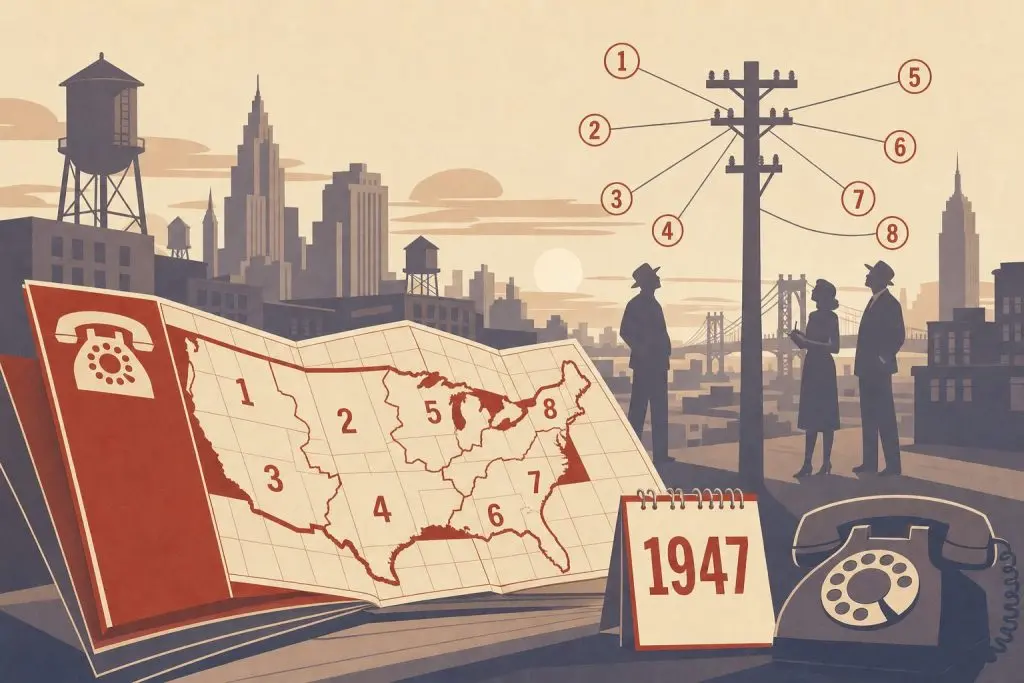
Area codes have only existed since 1947 — younger than most people assume. Before that, every town ran its own phone numbering system through a local switchboard operator, and a long-distance call meant a chain of human connections. This is the story of how North America moved from operator-only switching to the ten-digit number you punch into your phone today, and what comes next as the system approaches its limits.
Before Area Codes: The Operator Era
For roughly the first seventy years of telephone service in North America, there was no such thing as an area code. Every town or city ran its own local telephone exchange, staffed by switchboard operators who physically connected calls by inserting cables into a board. If you wanted to call someone across town, you picked up the phone, told the operator who you wanted to reach, and she — almost always she — completed the connection by hand.
Local numbering plans were just that: local. One town might assign customers three-digit numbers; the next town over might use four; a city might use a five-digit number prefixed with an exchange name like “PEnnsylvania 6” (the famous Glenn Miller song lyric is really a phone number). Each exchange administrator picked their own system and managed their own pool of numbers.
Long-distance calling worked, but it was slow and labor-intensive. Your local operator placed the call to a regional toll operator, who relayed it through one or more intermediate operators until it reached the destination exchange, where the final operator completed the connection. A coast-to-coast call could take minutes just to set up. As telephone use exploded in the early twentieth century, this system buckled under its own weight.
By the 1940s, AT&T and the independent telephone companies had a clear problem: the country needed a unified numbering scheme so that calls could eventually be dialed directly, without an operator handling every connection. The solution that emerged was the North American Numbering Plan.
Ready to Get a 212 Number?
One-time fee. No monthly charges. Port to any carrier in 3–5 business days. NYC's most trusted source since 2009.
Browse 212 Numbers →The NANP and the Birth of the Area Code
AT&T completed the North American Numbering Plan in 1947, in partnership with the independent operating companies. The NANP divided the United States and Canada into geographic regions called Numbering Plan Areas, each assigned a three-digit Numbering Plan Area code — what we now just call an area code. Mexico and several Caribbean territories were initially part of the plan; Mexico left in the 1990s to administer its own system, but much of the Caribbean remains in the NANP today.
The 1947 plan carved North America into 86 numbering plan areas, with 86 area codes assigned at launch. The numbering scheme itself was designed to accommodate up to 152 codes, leaving room for growth. Area boundaries generally followed existing state and provincial borders, though large states like California, Texas, and New York were split into multiple areas from the start.
New Jersey received the very first area code — 201. The District of Columbia got 202. New York City was assigned 212, Chicago took 312, and Los Angeles got 213. The assignment pattern was loosely tied to the rotary dial: areas expected to handle the most long-distance traffic received codes whose digits required the shortest dial pull, since each digit on a rotary phone took time proportional to its value. That’s why 212 — short pulls all around — went to the country’s busiest city.
Within each area, individual central offices (the local switching exchanges) received their own three-digit codes. Combine the central office code with a four-digit line number and you get the seven-digit local number that became the standard format. Layer the three-digit area code on top, and you have the ten-digit number every phone in North America still uses.
When Direct Dialing Actually Reached You
The 1947 plan was the blueprint, but Direct Distance Dialing — the ability for ordinary customers to dial a long-distance call themselves without an operator — rolled out gradually. The first DDD call was placed from Englewood, New Jersey to Alameda, California in November 1951. From there, the service spread across the country city by city through the 1950s and into the 1960s.
For most of the 1950s, area codes were a behind-the-scenes routing tool used mainly by operators. Customers in cities where DDD wasn’t yet available still placed long-distance calls through an operator and didn’t need to know the area code at all. By the mid-1960s most metropolitan areas had DDD, and the area code became something a typical household actually had to remember and use.
The original formatting rules for area codes reflected the limits of mechanical switching equipment. The first digit had to be between 2 and 9 — 0 was reserved for operator calls, and 1 was either ignored by switching equipment or reserved as a long-distance prefix. The middle digit was originally restricted to 0 or 1: a 1 indicated a state with multiple area codes, a 0 indicated a state with a single area code. The last digit could be anything 0 through 9.
This is why, if you look at the original 1947 area codes, you see a clear pattern: 212, 213, 214, 312, 313, 412, 414, 512, 513, 612, 614, 712, 713, 812, 814, 912 — all with 1 in the middle for multi-area states. And 201, 202, 203, 301, 302, 303 — all with 0 in the middle for single-area states. The pattern is decoded geography.
Running Out of Room: Splits, Overlays, and the 1995 Rule Change
The original constraint on the middle digit — only 0 or 1 — gave the system a hard ceiling of 152 possible area codes, and by the 1960s the most populous areas were already running short. Cities like New York and Los Angeles were exhausting central office codes within their assigned area, which meant either the area had to split or new dialing rules had to come.
Two solutions emerged. A split divides a geographic area into two or more new areas, with one retaining the original code and the others receiving new codes. Customers in the new area have to change their numbers. An overlay adds a new area code on top of the existing one in the same geographic area — existing customers keep their numbers, but new lines get the new code. The trade-off is that overlays force ten-digit local dialing, since the same neighborhood now has multiple area codes.
Manhattan’s progression is a textbook example. The borough started with 212, added 646 as an overlay in 1999, then added 332 in 2017. Customers on existing 212 lines never had to change their numbers; new lines got assigned from whichever code had inventory. That overlay history is why 212 numbers are still available today — they were never exhausted, just supplemented.
By the early 1990s the 152-code ceiling itself was the bottleneck. The North American Numbering Plan Administration changed the rules: starting January 15, 1995, the middle digit of an area code could be any digit 0 through 8, with 9 reserved for future expansion and special services. This expanded the pool from 152 to roughly 800 usable area codes. The first codes assigned under the new rule were 334 in Alabama and 360 in Washington State, both activated that same day.
Atlanta became the first city to require mandatory ten-digit local dialing in 1995 when its 770 overlay launched. The practice spread quickly: today most major metro areas use overlays, and ten-digit dialing for local calls is the norm. In 2021 the FCC mandated ten-digit dialing nationwide as part of the rollout of the 988 Suicide and Crisis Lifeline, since seven-digit local dialing could conflict with 988 in certain areas.
Special-Purpose Codes
Not every three-digit code in the NANP is a geographic area code. The plan reserved several special-purpose ranges:
Toll-free codes: 800, 888, 877, 866, 855, 844, 833. These route to any destination chosen by the subscriber, with the receiving party paying for the call instead of the caller. 800 was the first, introduced in 1966.
Premium-rate codes: 900. The caller pays a per-minute charge that’s split between the carrier and the service provider. Once common for hotlines and information services, now mostly obsolete.
Personal communication services: 500 and 533. Designed for follow-me numbers that route to wherever the subscriber happens to be. Never caught on widely.
Non-geographic short codes: 911 (emergency), 988 (Suicide and Crisis Lifeline), 988 (mental health crisis), 411 (directory assistance), 311 (non-emergency city services), 211 (community services), and 511 (traffic information). These three-digit codes work nationally but route to local resources based on where the call originates.
What Comes Next
The 1995 expansion bought decades of capacity, but North America keeps adding lines — mobile, VoIP, machine-to-machine devices, fax-replacement DIDs, every new business line. The North American Numbering Plan Administration tracks projected exhaust dates and publishes them annually, and the long-term trend is clear: at some point, ten-digit numbering will need to change.
Several approaches have been floated. One is to expand the area code itself to four digits — moving from a 10-digit national number to an 11-digit number. Another is to expand the central office code or the line number. A third is to allow the digit 9 in the middle position of area codes, which is currently held in reserve. None of these proposals has been adopted, and the eventual decision will likely be made well in advance of actual exhaust to give carriers and customers time to adapt.
For now, the system AT&T sketched out in 1947 — three digits for the area, three for the local exchange, four for the line — continues to power every phone call placed in North America. Pretty good run for a numbering plan designed when most phones were still rotary.
Frequently Asked Questions
When were area codes invented?
AT&T and the independent telephone companies completed the North American Numbering Plan in 1947, which is when the modern three-digit area code was created. Direct customer use of area codes spread gradually through the 1950s and 1960s as Direct Distance Dialing reached more cities.
What was the first area code ever assigned?
201, assigned to New Jersey. Washington, D.C. got 202, New York City got 212, Chicago got 312, and Los Angeles got 213. The original 1947 plan assigned 86 area codes across the United States and Canada.
Why did New York City get 212?
The 1947 assignments were loosely tied to expected call volume and the mechanics of the rotary dial. Each digit on a rotary phone took time to pull and return, with higher digits taking longer. Areas expected to handle the most long-distance traffic got codes with shorter dial pulls — 212 is one of the shortest possible combinations, which is part of why a 212 number carries the prestige it does today. For more on this history, see our piece on the history and prestige of 212 area code phone numbers.
How many area codes are there now?
The active count changes as new codes are activated and a few are retired. Active geographic and non-geographic codes in the NANP number in the high 300s as of 2026, plus reserved codes for future use.
Why did ten-digit dialing become required?
Overlay area codes put multiple codes in the same geographic region, which means seven-digit dialing can’t uniquely identify a destination. The FCC mandated ten-digit dialing nationwide in 2021 to clear the path for the 988 Suicide and Crisis Lifeline rollout, since 988 conflicted with seven-digit numbers beginning with 988 in some local exchanges.
Why isn’t there a 1, 0, or 9 in the middle of older area codes?
The original 1947 rules only allowed 0 or 1 in the middle position. After the 1995 rule change, any digit 0 through 8 became allowed in the middle, which is why newer codes like 332, 347, 646, and 786 have non-traditional middle digits. The 9 is still reserved for future use and special services.
Will we ever run out of area codes?
Eventually, yes. The NANP Administration tracks projected exhaust dates and updates them regularly. Several expansion proposals have been studied — adding a digit to the area code, the central office code, or both — but no plan has been adopted yet. Expect changes well in advance of actual exhaust.
Can I still get a 212 number today?
Yes. 212 was never exhausted; new lines just got assigned from overlay codes (646, then 332) when 212 inventory ran low. Existing 212 numbers turn over as businesses and individuals release them, which is how we maintain inventory. Numbers start From $150.
What’s the difference between an area code and a country code?
A country code identifies a country in the international dialing plan; +1 is the country code for the entire NANP region (United States, Canada, and participating Caribbean nations). Area codes identify regions within that country code. When you dial internationally, you dial your country’s international prefix, then the destination country code, then the area code, then the local number.
Ready to Get Your 212 Number?
If reading about how 212 ended up with such a short, recognizable code has you thinking about claiming one for yourself, the path is straightforward. Browse current inventory to see what’s available — numbers start From $150 — or call us at (212) 580-2000 with questions about a specific number or about porting it onto your existing carrier.
