

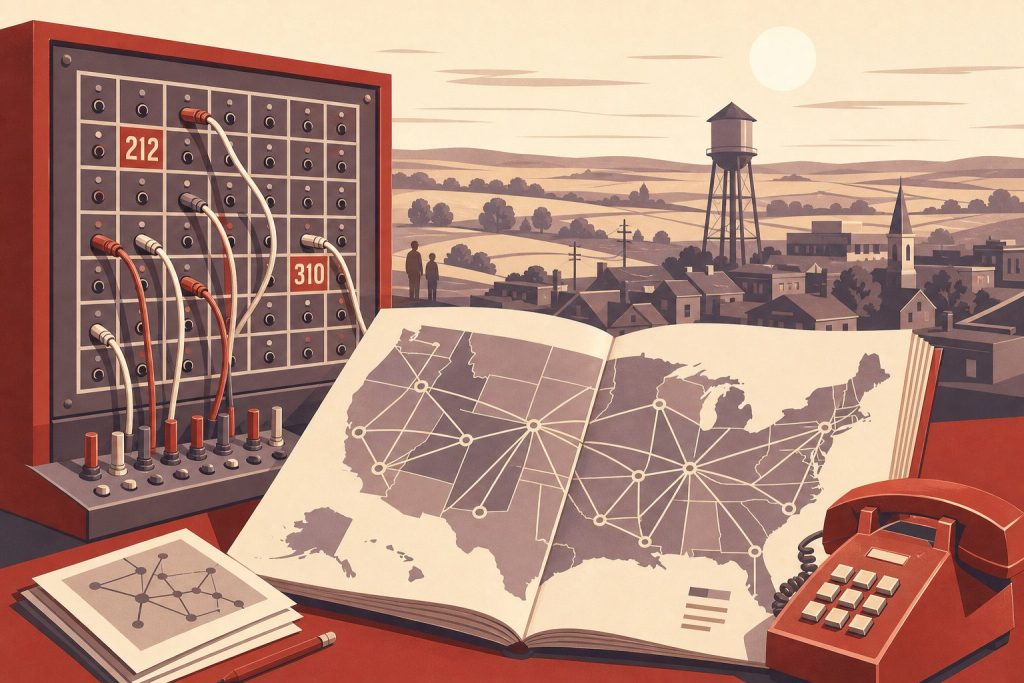
Area codes used to be optional for local calls. In most of the United States, that stopped being true years ago — and in 2021, the FCC made 10-digit dialing the rule everywhere. This post explains why area codes are now required even for the number next door, how the overlay system created that change, and what it means for anyone with a 212 number in Manhattan.
Area codes are not a new idea. The system used today from New York to Los Angeles was introduced in 1947 to handle the rapid expansion of telephone use across the country. Back then, you only dialed the area code when calling outside your local region. Inside your own area code, seven digits were enough. That convention held in most of the U.S. for nearly fifty years.
Today, that’s mostly gone. In any region with an overlay area code — and that now includes Manhattan, all of New York City, and roughly two-thirds of the U.S. by population — every call requires all ten digits, even to your next-door neighbor. Here’s why the rules changed and how they affect anyone using a 212 number.
What Counts as a Local Call
A local call is a call placed within your own local calling area — historically, the geographic region served by the same area code, sometimes including portions of adjacent area codes that the phone company treated as local for billing purposes. Local calls used to be free or unmetered on most landline plans, which is why the distinction mattered to consumers.
On modern wireless plans, the “local vs long-distance” distinction has almost no practical meaning. Every major U.S. wireless plan now includes unlimited domestic calling, so a call from Manhattan to Brooklyn costs the same as a call from Manhattan to Manhattan — which is to say, nothing extra. The distinction lives on in dialing rules and in how phone numbers are administered, even if it no longer shows up on your bill.
Ready to Get a 212 Number?
One-time fee. No monthly charges. Port to any carrier in 3–5 business days. NYC's most trusted source since 2009.
Browse 212 Numbers →Why Phone Numbers Ran Out
The simplest reason area codes matter so much in 2026 is that phone numbers are scarce. The North American Numbering Plan assigns ten digits in a fixed format: three-digit area code, three-digit central office code, four-digit subscriber number. That gives roughly eight million usable numbers per area code, minus the blocks reserved for system use.
When 212 was assigned to all of New York City in 1947, that pool was vast. Most households shared a single line. Businesses had one main number. Cell phones did not exist. By the 1980s, fax machines, modems, second lines, and pagers were eating into the pool. By the 2000s, every person in the household carried a mobile number of their own. Numbers that used to last a region for decades were exhausted in years.
The same pattern played out everywhere. Los Angeles split 213 into multiple codes. Chicago split 312. New York split 212 into 212 and 718 in 1984, then added 917 as an overlay in 1992, then 646 in 1999, then 347, then 929, then 332. Each new code added millions of usable numbers without renumbering the existing ones.
The Overlay System
When a region runs out of numbers, the phone industry has two options: split the region geographically and assign one area code to each piece, or overlay a new area code on top of the existing one. Splits used to be the default. Overlays are the default now.
A split is disruptive — half the residents and businesses in a region get a new area code, have to reprint stationery, update marketing materials, and notify customers. An overlay adds a new area code that coexists with the old one. New numbers issued in the region might be in either code. Existing numbers don’t change. This is why Manhattan has 212, 646, and 332 all active at the same time, and why your neighbor’s cell phone might have a different area code from yours even though you live in the same building.
The tradeoff is that overlays require ten-digit dialing. If two phones in the same building have different area codes, you can’t tell from the seven-digit number alone which one you’re calling. The network needs the full ten digits to route correctly.
10-Digit Dialing Became Mandatory
For decades, ten-digit dialing was required only in regions with overlays — New York City, Los Angeles, Chicago, and a growing list of others. Outside those regions, seven-digit local dialing still worked.
That changed in 2021. The Federal Communications Commission required every area code in the U.S. that still allowed seven-digit local dialing to convert to mandatory ten-digit dialing by October 24, 2021. The reason was practical: the new 988 Suicide and Crisis Lifeline was launching nationally, and the FCC needed to free up the “988” prefix in every area code. In any region where a seven-digit local number could start with 988, callers would otherwise have no way to know whether they were dialing the crisis line or a neighbor.
The result is that ten-digit dialing is now the universal U.S. standard. Even in rural areas with no overlay, you dial the area code for every call. The transition is complete; the old seven-digit habit no longer works anywhere.
What This Means for a 212 Number
If you own or are considering a 212 number, the dialing rules work in your favor. Every call to your number requires the full 212-XXX-XXXX, which means every caller sees and dials the Manhattan area code. The prestige cue is reinforced by the dialing pattern itself. Customers and contacts who store your number see the 212 prefix in their phone every time they call.
The same is true in reverse. When you call out from a 212 number, recipients see the 212 area code on their caller ID. In a city where 212 has historic associations with established Manhattan businesses and long-time residents, that signal carries weight — a point we cover in more depth in our post on the prestige of 212 area code phone numbers.
Frequently Asked Questions
When did area codes become required for local calls?
In regions with overlay area codes, ten-digit local dialing has been required since the late 1990s. Nationwide, the FCC required every U.S. area code to convert to mandatory ten-digit dialing by October 24, 2021, to free up the 988 prefix for the Suicide and Crisis Lifeline. Seven-digit local dialing no longer works anywhere in the U.S.
What is a local calling area?
Historically, the local calling area was the geographic region the phone company treated as local for billing — usually the same area code, sometimes including adjacent ones. On modern wireless plans with unlimited calling, the local-vs-long-distance distinction no longer affects what you pay, but it still defines how numbers are administered and assigned.
What does “overlay area code” mean?
An overlay is a new area code added on top of an existing one in the same geographic region, instead of splitting the region. Manhattan has three overlay area codes serving the same physical territory: 212, 646, and 332. Overlays let phone companies add new numbers without changing anyone’s existing number, but they require ten-digit dialing for every call within the region.
Why do I have to dial the area code if I’m calling my neighbor?
Because your neighbor might be in a different area code. In any overlay region — and that includes most large U.S. cities — two phones in the same building can have different area codes. The network needs all ten digits to know which number to ring. Even in non-overlay regions, the FCC’s 2021 rule made ten-digit dialing universal.
How do area codes actually work when I dial?
When you dial ten digits, the network reads the first three digits to identify the area code, then looks up the routing record for the full number in a national database. That database tells the network which carrier currently owns the number — whether it’s a Verizon wireless line, a Vonage VoIP account, or a Spectrum landline. The lookup happens in milliseconds, which is why calls connect almost instantly. We go deeper on this in our guide to how area codes work.
Does ten-digit dialing apply to text messages too?
Yes, and it always has. Text messages have always required the full ten-digit number — the seven-digit dialing convention only ever applied to voice calls. If you’ve been texting in the U.S. anytime in the last twenty years, you’ve already been using ten-digit addressing.
What happens if I dial only seven digits today?
You’ll get a recorded message telling you the call cannot be completed as dialed and to please dial the area code. Some carriers route the call to a generic error tone. Either way, the call won’t go through. The seven-digit habit is fully retired in 2026.
Do I dial “1” before the area code for local calls?
It depends on your carrier and your line type. On most U.S. wireless plans, dialing “1” before the area code is optional — the network accepts either ten or eleven digits. On some landlines and VoIP services, the “1” is required for calls outside the local rate center and optional for calls inside it. When in doubt, dial 1+area code+number; it works everywhere.
Ready to Get a 212 Number?
Every number in our shop is a real Manhattan 212 area code line, ready to port to your wireless carrier, VoIP service, or landline provider. Numbers start From $150 depending on the digit pattern. Browse current inventory to see what’s available, or call us at (212) 580-2000 if you’d like help choosing the right number for your business or personal line.
