

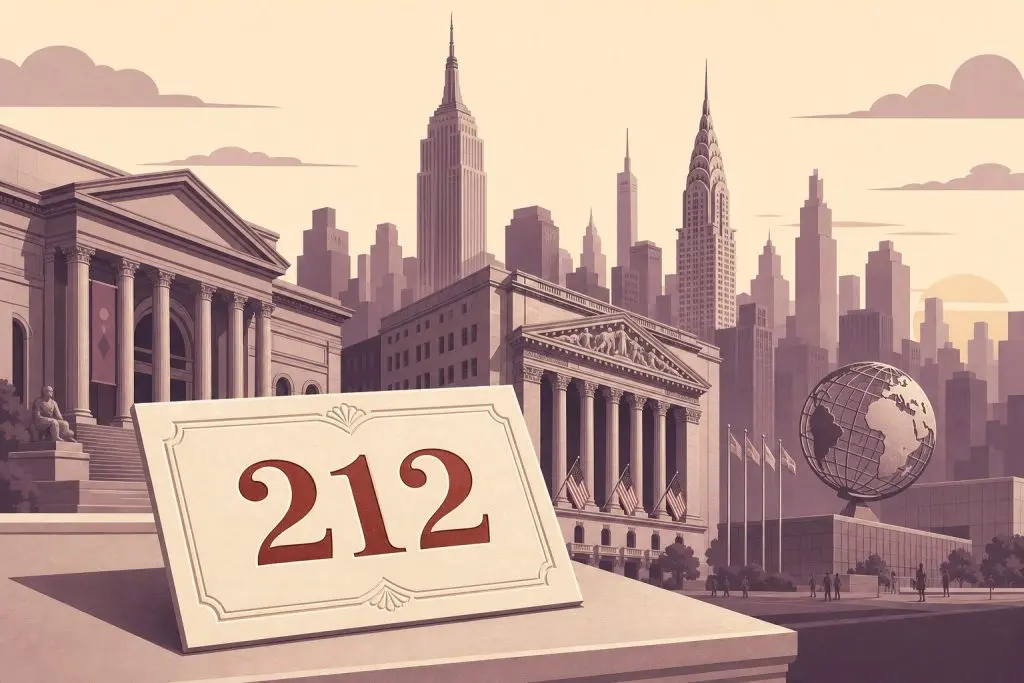
Area code 212 carries more weight than any other set of three digits in American telecom. It is the original New York City area code, restricted to Manhattan since the late 1980s, and it functions as shorthand for established, serious, here-since-the-beginning. This guide explains where the prestige actually comes from, who uses 212 today, and what it takes to get one in 2026.
Where the Prestige of 212 Comes From
The 212 area code was assigned to New York City in 1947 as part of the original North American Numbering Plan — the same rollout that gave Los Angeles 213 and Chicago 312. At the time, the digits on a rotary phone took longer to dial the higher they went, and the busiest cities were intentionally given the fastest-dialing codes. 212 was the fastest of all: two short pulses and one slightly longer one. Manhattan got the prime number because Manhattan was the prime market.
That history matters because every other Manhattan area code came later, and each one was created to handle overflow that 212 itself could no longer absorb. The 718 overlay split off the outer boroughs in 1984. The 917 overlay arrived in 1992 as a wireless-and-pager code across all five boroughs. The 646 overlay was added to Manhattan in 1999, then 332 in 2017, and a brand new 465 overlay was announced for the borough as well. Each new code is a quiet reminder that 212 came first.
By the late 1990s, 212 numbers were no longer being handed out to new customers in normal allocation — the supply was effectively closed. That scarcity, layered onto seven decades of association with New York’s most recognizable institutions, is what turned a phone number into a status signal.
Why a 212 Number Still Signals Something
Three things give 212 its weight, and all three have held up surprisingly well into the smartphone era.
Ready to Get a 212 Number?
One-time fee. No monthly charges. Port to any carrier in 3–5 business days. NYC's most trusted source since 2009.
Browse 212 Numbers →It signals Manhattan, specifically. 718 reads as outer boroughs. 917 reads as a New Yorker, but a New Yorker who got their cell phone after 1992. 646 and 332 read as Manhattan, but as Manhattan numbers the carrier handed out because 212 was already gone. Only 212 reads as original Manhattan — the address-equivalent of a downtown loft someone’s grandfather bought in 1962.
The United Nations, the New York Stock Exchange, the Metropolitan Museum of Art, most of the city’s oldest law firms, and most of the original Madison Avenue advertising houses are still reachable on 212 numbers. When a caller sees those three digits on caller ID, the implied category is “established institution,” not “startup that opened last quarter.”
It signals longevity. Because new 212 allocations effectively stopped before the dot-com boom, almost any 212 number a person or business is using today either dates back decades or was acquired on the secondary market. Either reads as a deliberate choice. There is no accidental 212 number — somebody had to want it.
It outperforms in real call data. Outside New York, area codes have flattened in meaning because cell numbers travel with their owners. Inside New York, the opposite happened. Marketing tests in the city consistently show better answer rates and better response rates for outbound calls from a 212 number than from any other NYC area code. The difference is not subtle. A 332 or 646 cold call still pulls a Manhattan-aware audience, but a 212 cold call pulls one and signals tenure on top of it.
Who Actually Uses 212 Today
The roster of 212 holders runs across four broad groups.
Legacy institutions and old-line businesses. Banks, law firms, museums, universities, theaters, hospitals, and media companies whose main line was assigned decades ago and has never moved. These are the numbers people associate with 212 most directly.
Long-time Manhattan residents. Anyone who had a Manhattan landline before 1999 likely still has a 212 number if they kept the line. Many of those numbers have been ported to cell phones over the years and now live on a wireless carrier with the original three digits intact.
Founders and operators who deliberately chose one. Startups and small businesses that want to register as serious New York operations without spending years building up the perception. Tech founders in particular have been buying 212 numbers since the early 2010s because the digits map directly onto credibility in pitch meetings and on press release boilerplate.
Remote operators who want a New York presence. Consultants, attorneys, talent reps, and brokers who serve New York clients but don’t live in the city. A 212 number on the contact page is the cheapest, fastest way to register as locally available. Because every modern phone supports a second line via eSIM, the 212 can live alongside a personal number on the same device.
Are 212 Numbers Still Available?
Yes — but not through normal carrier channels. New allocations from the North American Numbering Plan in 212 effectively stopped years ago, and the few that occasionally get released back to general inventory disappear within hours. The practical path is the secondary market, which exists precisely because the official channel is closed.
Numbers come back into circulation when a business shuts down, a long-time holder ports out and lets the line lapse, or a carrier releases an old block back to the inventory pool. We acquire those numbers as they become available and list them in the shop, sorted by digit pattern, memorability, and the kind of repetition that makes a number stick (triples like 212-XXX-1111, sequential runs, palindromes, etc.).
For more context on how the broader Manhattan area code map looks today, see our overview of how 212, 646, and 332 fit together and what each one signals in practice.
What It Takes to Get One
Owning a 212 number is mechanically simple in 2026. You buy the number from a reseller (like us), and your wireless carrier ports it onto your existing line. The port itself usually finishes within a few hours on a wireless-to-wireless transfer, and the FCC requires simple ports to complete within one business day regardless of carrier.
You do not have to change carriers, change phones, or live in New York. You do not need a physical SIM card — every modern iPhone and most flagship Android phones support eSIM, so the 212 number can be activated as a second line on the device you already use. The original number you had before the port stays on the device too, on its own line.
Pricing on 212 numbers reflects digit pattern, memorability, and rarity. Numbers start From $150, with higher-end vanity patterns priced accordingly. Once you own the number, it’s yours permanently — you can port it to any carrier at any time, and the FCC bars your old carrier from charging a release fee.
Frequently Asked Questions
Why is 212 considered more prestigious than 646 or 332?
All three codes serve Manhattan, but only 212 has been doing so since 1947. 646 was added in 1999 as an overlay and 332 in 2017. Anyone with a 212 number either had it before the overlays existed or deliberately acquired one on the secondary market — neither of which is true of a randomly assigned 646 or 332.
Can I get a 212 number from my regular carrier?
No. T-Mobile, Verizon, and AT&T don’t allocate new 212 numbers in normal activation because the available pool from the North American Numbering Plan is effectively empty. You’ll need to acquire one through a secondary-market reseller and then port it onto your carrier of choice.
Do I have to live in Manhattan to use a 212 number?
No. Wireless numbers travel with their owners; rate centers no longer restrict where you can use a wireless line day to day. Plenty of 212 holders live outside the city — the number signals Manhattan presence regardless of where the device is.
How rare are 212 numbers really?
Rare enough that they have to be acquired one at a time on the secondary market and never through automatic carrier assignment. They are far rarer than 917 or 646 numbers in particular, both of which carriers still assign by default.
Will a 212 number actually help my business?
In NYC-focused outbound calling and sales, yes — answer rates and response rates from 212 numbers consistently outperform other Manhattan area codes in field tests. In pitch meetings, on contact pages, and on business cards, a 212 line registers as established and locally serious. The lift is real but not magical; the number opens doors, not closes deals.
What’s the difference between buying a 212 number and using a Google Voice 212?
A 212 number purchased outright is a real telephone number you own and can port to any carrier at any time. A Google Voice 212 number is a forwarding number tied to your Google account, and Google Voice no longer offers free 212 numbers in normal signup because the pool is closed. The differences are explored at length in our piece on 212 numbers vs call-forwarding services.
How long does it take to get a 212 number active on my phone?
From purchase to active line, usually under a single business day. The port itself runs in the background through your wireless carrier, and most wireless-to-wireless ports finish within a few hours of the request being submitted.
Can I pick the specific digits?
You can pick from current inventory. We list every available 212 number in the shop with full digits visible, so you can choose based on pattern, memorability, or association. Custom vanity 212 numbers are also occasionally available — those are flagged separately in inventory when they appear.
Ready to Claim a 212 Number?
Every 212 number listed in our shop is acquired from the secondary market, verified, and ready to port to your current wireless carrier on a standard transfer. Numbers start From $150.
Browse current inventory to see what’s available right now, or call us at (212) 580-2000 if you’d like help choosing a number or have questions about the porting process for your carrier.
