

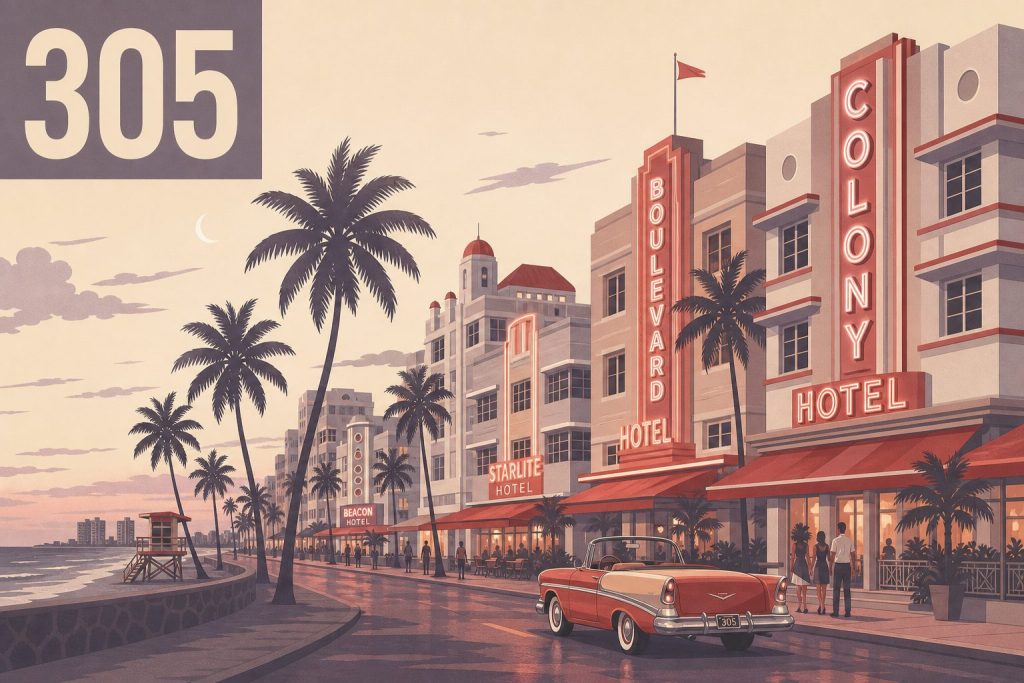
Area code 305 covers Miami-Dade County and the Florida Keys. One of the original 86 area codes assigned by AT&T in 1947, it was Florida’s first and only NPA for six years and has since become inseparable from Miami’s cultural identity — “Mr. 305,” “305 till I die,” and the celebrated 305 Day on March 5. For the full picture, see all Florida area codes.
| State | Florida |
|---|---|
| Primary city | Miami |
| Coverage area | Miami-Dade County and the Florida Keys (Monroe County) |
| Time zone | Eastern (UTC-5 / UTC-4 DST) |
| Year established | October 1, 1947 |
| Original 1947 NPA? | Yes — one of the original 86 |
| Originally served | All of Florida (1947–1953) |
| Overlay codes | 786 (1998), 645 (2024) |
| Ten-digit dialing? | Mandatory |
| Status | Active — pool nearing exhaustion (645 added 2024 to address it) |
The Original Florida Code
Area code 305 is the original area code of the state of Florida — one of the 86 NPAs assigned by AT&T when the North American Numbering Plan was created on October 1, 1947. For its first six years it covered the entire state, from Pensacola to Key West. Successive splits across half a century progressively narrowed the territory until 305 served only Miami-Dade County and the Florida Keys. In the same period, the code became something more than a phone prefix: it became Miami itself. Pitbull calls himself Mr. 305. Miami Heat fans wear it. Tattoos. T-shirts. A real annual holiday on March 5. “305 till I die” appears on graffiti, sneakers, and Instagram bios. No newer overlay code has come close to dislodging 305 as the marker of authentic Miami.
History of Area Code 305
When the first nationwide numbering plan went into effect on October 1, 1947, all of Florida received a single area code: 305. The Sunshine State’s population was about 2.8 million — small enough for one NPA to serve the entire peninsula. That changed quickly. As Florida’s population began its long postwar boom, the state was repeatedly subdivided: in 1953, 813 split off to cover the Tampa-St. Petersburg-Fort Myers Gulf Coast; on April 16, 1988, 407 split off central Florida (Orlando, Daytona Beach, the Space Coast); and on July 9, 1995, 954 split off Broward County (Fort Lauderdale, Hollywood, Pompano Beach). For a full breakdown of the state’s current numbering, see how many area codes are in Florida and what area codes are used in Florida.
The 1995 Broward split was the contested one. Stripping Fort Lauderdale and Hollywood of their 305 numbers caused immediate frustration and even litigation — by 1995, the 305 prefix already carried meaningful Miami-metro identity, and Broward residents who suddenly had 954 numbers felt downgraded. The split happened anyway, leaving 305 with only Miami-Dade and the Florida Keys (Monroe County). The reduced 305 pool was exhausted within three years, prompting the first overlay: 786, activated on March 1, 1998 — the first overlay area code in Florida. The Miami-Dade and Keys territory continued to grow, and a second overlay, 645, was activated on October 19, 2024 to address the next round of exhaustion. All three codes (305/786/645) now share the same geography, and ten-digit dialing has been mandatory in the territory since 1998.
Coverage Area
Area code 305 today covers Miami-Dade County and Monroe County (the Florida Keys) — roughly 2.8 million residents across a territory that runs from the Broward County line in the north to Key West in the southwest:
Ready to Get a 305 Number?
One-time fee. No monthly charges. Port to any carrier in 3–5 business days. NYC's most trusted source since 2009.
Browse 305 Numbers →- Miami — Downtown, Brickell, Wynwood, Little Havana, Coconut Grove, Coral Way, Edgewater, the Design District
- Miami Beach — South Beach, Mid-Beach, North Beach, the Art Deco Historic District
- Coral Gables — University of Miami, Miracle Mile, the Biltmore Hotel
- Hialeah — substantial Cuban-American community, one of the largest Spanish-majority cities in the US
- Homestead, Kendall, Doral, Aventura — outer Miami-Dade communities
- The Florida Keys — Key Largo, Islamorada, Marathon, Key West, and the entire island chain south of the mainland
Nearby Florida area codes include 954 (Broward — Fort Lauderdale), 561 (Palm Beach), 239 (Naples/Fort Myers), 407 (Orlando), 813 (Tampa), 904 (Jacksonville), and 321 (Space Coast). All three Miami-Dade codes — 305, 786, and 645 — overlay the same territory; new phone lines may be assigned from any of them.
The Cultural Weight of a 305 Number
The 305 area code has become a cultural shorthand for Miami in a way that few American area codes manage — comparable to 212 for Manhattan or 310 for West LA, but tied to a city whose identity is unusually compressed into specific eras and aesthetics. 305’s cultural canon includes the Art Deco resort city of the 1930s, the 1980s Cocaine Cowboys era documented in Scarface and Miami Vice, the Latin American banking and immigration capital of the 1990s, and today’s global city anchored by Brickell finance and the Wynwood arts district. The prefix runs through Miami hip-hop from the Uncle Luke / 2 Live Crew Miami bass era through DJ Khaled and Pitbull, into film (Bad Boys, the Michael Mann visual canon), and into everyday Miami pride.
Pitbull — born Armando Christian Pérez in Miami in 1981 — has built his entire international brand around the prefix. He calls himself “Mr. 305,” operates a record label named Mr. 305 Inc., and received the Key to Miami from Commissioner Thomas Regalado in 2009, an honor explicitly tied to his role as the city’s musical ambassador. In 2025, Florida International University renamed its football stadium Pitbull Stadium — the first US athletic venue named after a recording artist — cementing the prefix’s place in Miami’s institutional identity. Beyond Pitbull, the cultural rituals are everywhere: 305 Day on March 5 (3/05) is a real annual holiday celebrated with cafecito specials, restaurant deals priced at $3.05, and city events. The 3:05 p.m. cafecito break — a colada poured from a walk-up window into thimble cups, shared among coworkers — is genuine Miami office culture. “305 till I die” appears on graffiti, sneakers, Miami Heat jerseys, and tattoos as the standard declaration of Miami nativity or long-tenured residence.
305 vs. 786 vs. 645: The Miami Vintage Hierarchy
Three area codes serve Miami-Dade and the Keys, and like every overlaid metro, they form a clear vintage hierarchy. 305 dates to 1947 and reads as authentic Miami — someone with a 305 number is either Miami-born, long-tenured Miami resident, or specifically sought one out. 786 dates to 1998 and reads as post-1998 Miami arrival — established but post-explosion. 645 dates to 2024 and reads as newcomer — assigned during the post-pandemic Miami boom. No newer overlay has displaced 305’s heritage status in nearly eight decades.
Frequently Asked Questions About Area Code 305
Where is the 305 area code?
305 covers Miami-Dade County and the Florida Keys (Monroe County). Major cities include Miami, Miami Beach, Coral Gables, Hialeah, Homestead, Kendall, Key Largo, and Key West.
When was area code 305 created?
October 1, 1947. It was one of the original 86 area codes assigned by AT&T at the launch of the North American Numbering Plan, and it originally covered the entire state of Florida.
What’s the difference between 305, 786, and 645?
All three serve the same geographic territory — Miami-Dade County and the Florida Keys. They differ only in vintage: 305 dates to 1947, 786 to 1998, and 645 to 2024. Calls between them are local. Ten-digit dialing is mandatory.
Is the 305 area code still being assigned to new lines?
Increasingly rarely. The 305 prefix pool has been near exhaustion for years, which is why 786 was added in 1998 and 645 in 2024. Most new Miami-Dade lines today are assigned 786 or 645 prefixes. New 305 assignments come from churn and the residual unassigned pool, both of which are minimal.
What is “Mr. 305”?
It’s the stage nickname of Miami-born rapper Pitbull (Armando Christian Pérez), tied to the 305 area code as the marker of his Miami identity. Pitbull built his record label, Mr. 305 Inc., around the moniker and received the Key to Miami in 2009 in recognition of his role as the city’s musical ambassador.
What is 305 Day?
March 5 (3/05) — an annual Miami holiday celebrating the area code as a symbol of city identity. Restaurants run cafecito specials and $3.05 promotions, the Wynwood Walls offer $3.05 admission, and city events and Pitbull look-alike contests have become traditional. The day grew organically from the 3:05 p.m. cafecito break, a Miami office ritual where a hot colada is shared among coworkers in thimble cups.
Is 305 a scam area code?
No. 305 is a legitimate, active area code for Miami-Dade County and the Florida Keys. Like any area code, scammers occasionally spoof 305 caller IDs, but the code itself is heavily used by real Miami businesses, government offices, and residents.
How to Get a 305 Phone Number
There are three ways to acquire a 305 phone number today:
- Sign up with a VoIP carrier. Google Voice, OpenPhone, Grasshopper, and similar services can occasionally provision a 305 number on request, though assignments have become rare as the 305 pool runs dry.
- Port an existing 305 number. If you already have a 305 number with another carrier, you can transfer it to a new service provider while keeping the digits. Works for landlines, cell phones, and VoIP. Learn how porting works.
- Buy from a specialist who holds curated inventory. Number brokers like 212areacode.com hold catalogs of available 305 numbers and sell them with a one-time fee, no recurring carrier charges. This is the only reliable option for choosing a specific memorable Miami number.
212areacode.com has been a curated source for premium area code numbers since 2009, with 305 inventory across Random, Business Class ($150+), Exclusive ($300+), and Wholesale Block tiers. Browse current 305 inventory or call (212) 580-2000.
