

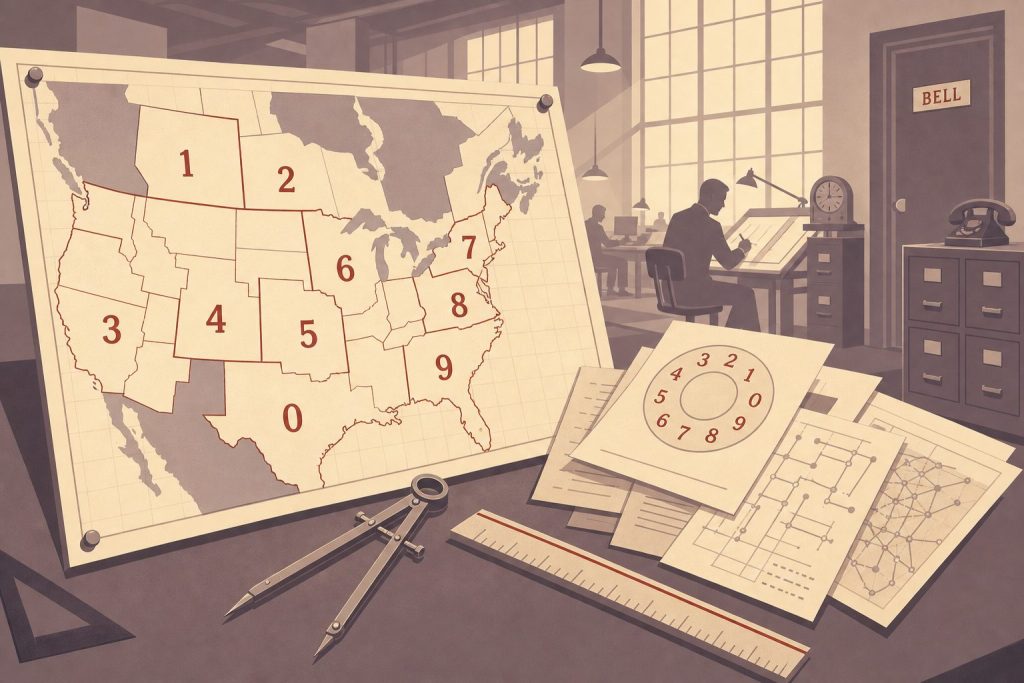
Area codes were invented in 1947 by engineers at AT&T and Bell Laboratories as part of the North American Numbering Plan. The work is usually credited to a small team led by W. G. Thompson and including Ken Hopper, who designed the three-digit geographic codes that made direct long-distance dialing possible. This post walks through who actually built the system, why it looked the way it did, and how the original 1947 plan still shapes phone numbers in 2026.
The Problem Area Codes Were Built to Solve
By the mid-1940s, the US phone network was running into a wall. Every long-distance call had to pass through a human operator, often through a chain of two or three of them, each one manually plugging cords into a switchboard to route the call to the next city. A call from New York to Los Angeles could involve four operators and take several minutes just to connect. The system worked, but it did not scale, and AT&T’s traffic forecasts showed call volume outgrowing operator capacity within a few years.
The fix had to do two things at once. It had to let customers — or at least operators in the originating city — dial long-distance calls directly into the destination switch without manual relays. And it had to do that without requiring every phone in North America to be renumbered. The answer was a layered addressing system: a short numeric prefix that pointed to a geographic region, followed by the existing local number. The prefix became the area code.
Who Actually Invented Area Codes
The North American Numbering Plan was developed inside AT&T and Bell Laboratories during the mid-1940s and launched in 1947. The work was distributed across a team rather than the product of a single inventor, which is part of why no one name dominates the popular history.
The plan itself is usually credited to W. G. Thompson and a small group of AT&T traffic engineers who designed the numbering scheme, the geographic partitioning, and the routing logic that the new long-distance switches would use. Ken Hopper, also at AT&T, is frequently named in connection with the project for his work on the underlying switching and signaling systems that made direct distance dialing possible. The system itself was a Bell Labs and AT&T joint effort, drawing on switching research and call-routing studies that had been in progress for years before 1947.
Ready to Get a 212 Number?
One-time fee. No monthly charges. Port to any carrier in 3–5 business days. NYC's most trusted source since 2009.
Browse 212 Numbers →You will sometimes see Claude Shannon’s name attached to the story. Shannon was at Bell Labs in this era and his 1948 paper founded modern information theory, but the documented record connects the NANP design to the traffic engineering and switching teams rather than to Shannon’s mathematical work. The cleaner statement is that area codes came out of AT&T and Bell Labs as an institution, with Thompson, Hopper, and their colleagues doing the specific design.
How the 1947 Plan Worked
The original 1947 rollout divided the United States and Canada into 86 numbering plan areas, each assigned a single three-digit code. The codes were not random. They were shaped by two technical constraints from the rotary-dial telephones of the era.
First, the middle digit had to be either 0 or 1. Long-distance switches needed a fast, unambiguous way to recognize that an incoming string of digits started with an area code rather than a local number, and the middle 0-or-1 was the flag. Second, area codes could not start with 0 (reserved for operator) or 1 (reserved for long-distance signaling). That left N0X or N1X formats — where N is 2 through 9 — giving 160 possible codes in total.
The most populous regions got the codes that were fastest to dial on a rotary phone, because the dial returned to zero more slowly for higher digits. New York City got 212 — three pulses, one pulse, two pulses — the lowest possible total. Los Angeles got 213. Chicago got 312. Smaller and less-trafficked regions got codes with higher digit sums like 906 (Michigan’s Upper Peninsula) or 807 (northwestern Ontario). The result was a numbering plan that was efficient on the hardware of the day and still carried information about a region’s call volume just from the shape of its code.
The first customer-dialed long-distance call using the new system was placed on November 10, 1951, when the mayor of Englewood, New Jersey dialed the mayor of Alameda, California directly, without operator assistance, using area code 415. Direct distance dialing rolled out city by city through the 1950s and 1960s.
Why the System Lasted
The 1947 plan was designed for electromechanical switching equipment that has long since been replaced, but the addressing scheme outlived the hardware because it was a clean, layered design. The phone number is split into three independent pieces — area code, central office prefix, line number — and each piece can be looked up separately in routing tables. When the network moved to digital switches in the 1970s and 1980s, and then to packet-switched VoIP in the 2000s, the routing logic changed underneath but the numbering plan did not have to.
The plan also turned out to be expandable. The original 86 area codes covered the entire continent in 1947, but as phone density grew, regions were split into smaller numbering plan areas — each getting its own code. The 0-or-1 middle digit rule was dropped in 1995 to free up more codes, which is why area codes like 332, 347, 646, and 929 (all New York City overlays) exist today. The expansion has not required redesigning the system, only allocating new codes from a larger pool.
What’s Changed Since 1947
Three things have shifted the practical meaning of an area code, even though the underlying NANP is still the same plan.
Geographic splits gave way to overlays. Until the mid-1990s, when a region ran out of numbers, the regulator would split it into two and assign a new area code to one of the halves — meaning half the existing customers had to change their numbers. Customers hated this. Starting in the late 1990s, overlays replaced splits as the standard fix: a new area code is layered on top of the same geography, so existing numbers stay put and only new numbers get the new code. Manhattan’s 332 overlay (added in 2017) is a clean example. The original 212 numbers in Manhattan never changed, and 332 just started filling in where 212 had run out.
Numbers stopped being tied to physical locations. Wireless local number portability, mandated by the FCC in 2003, let any number move with the customer between carriers and devices. VoIP services like Vonage and Google Voice broke the geographic tie entirely — a 212 number can ring a phone in any city or any country with internet access. The area code still encodes the rate center the number was originally assigned to, which matters for some billing and routing questions, but for the user it has become more of a brand than a location signal.
NANP exhaustion is now a slow-moving operational issue rather than a crisis. The Numbering Administration tracks the rate at which available codes are being assigned, and projections published by the regulator show the current pool lasting well into the 2050s under typical assignment rates. Number recycling, more aggressive number-pool management, and the gradual shift of low-volume use cases (like fax) toward shared numbers have all extended the runway.
Why Area Code 212 Still Carries Weight
Because 212 was one of the original 1947 codes — assigned to the most-dialed region in the country on the hardware of the era — it has a kind of seniority that newer codes do not. It is the oldest area code in continuous use for New York City, and after Manhattan added the 646 overlay in 1999 and the 332 overlay in 2017, most new phone lines in Manhattan get one of those newer codes rather than 212. Existing 212 numbers stayed where they were, but the supply of fresh 212 numbers is limited, which is why they are sought after for businesses and individuals who want a Manhattan presence with an authentically old-school code.
For more on the historical assignment process, see our post on how area codes are assigned, and for a deeper look at how the system still works in 2026, see how area codes work.
Frequently Asked Questions
When was the first area code created?
The first area codes were assigned in 1947, when AT&T and Bell Labs launched the North American Numbering Plan. They were not used by ordinary customers right away — the first customer-dialed long-distance call using an area code did not happen until November 10, 1951.
What was the very first area code used?
The honor of the first customer-dialed long-distance call goes to area code 415 (San Francisco Bay Area), which was the destination code in the 1951 Englewood-to-Alameda call. All 86 original area codes were assigned at the same time in 1947, so there is no single “first” code in the assignment sense — but 415 was the first one used in a fully direct-dialed call.
Who invented area codes?
Area codes were designed by a team of engineers at AT&T and Bell Laboratories. W. G. Thompson is generally credited with leading the numbering plan design, with Ken Hopper and a broader team contributing to the switching and routing systems that made direct distance dialing possible.
What does NANP stand for?
NANP stands for the North American Numbering Plan. It is the system that governs phone numbers in the United States, Canada, and 18 Caribbean nations. The plan was launched in 1947 and is still the foundation of phone numbering in all participating countries.
How many area codes were there originally?
The 1947 plan divided the US and Canada into 86 numbering plan areas, each with a single three-digit code. As of 2026, there are several hundred active area codes in the NANP — the original 86 plus all of the splits and overlays added since.
Why does New York City have area code 212?
In 1947, area codes were assigned partly based on how fast they were to dial on a rotary phone. Lower-digit codes dialed faster, so the most populous regions got them. New York City, the largest metro area in the country, got 212 — the fastest code to dial on a rotary phone. New York City now has several area codes, but 212 is the original.
What is the oldest area code in the United States?
All 86 original area codes were assigned simultaneously in 1947, so any of them qualifies as the oldest. Among the more recognizable: 212 (New York City), 213 (Los Angeles), 312 (Chicago), 215 (Philadelphia), 313 (Detroit), and 415 (San Francisco). None of those codes has been retired, though some have shrunk geographically as new codes were carved out around them.
Why do area codes have the format they do?
The 1947 plan required the middle digit to be 0 or 1, so that long-distance switches could quickly distinguish an area code from a local number. The first digit could not be 0 (reserved for operator) or 1 (reserved for long-distance signaling). That rule was relaxed in 1995 to expand the pool of available codes, which is why modern codes like 332 (Manhattan) and 929 (NYC outer boroughs) have non-traditional formats.
How did area codes work before automated dialing?
For the first few years after 1947, area codes were used by long-distance operators rather than by customers directly. When you placed a long-distance call, you told the operator the city you wanted, and the operator used the area code internally to route your call through the appropriate trunk lines. Direct customer dialing of area codes rolled out city by city starting in 1951 and took roughly two decades to reach full national coverage.
Will we run out of area codes?
Not soon. The numbering plan has been expanded several times since 1947, most significantly by dropping the 0-or-1 middle-digit rule in 1995, which roughly quadrupled the available pool. Current projections from the numbering administration show the NANP lasting well into the second half of the century at typical assignment rates, and number-pool management is steadily extending that runway.
Want an Original 1947 Area Code on Your Phone?
Manhattan’s 212 area code is one of the 86 original codes from the 1947 NANP rollout — and despite three overlays since, real 212 numbers are still available for purchase. Browse current inventory to see what is available right now, with numbers starting From $150. Call us at (212) 580-2000 if you would like help choosing a number or have questions about porting it to your carrier.
