
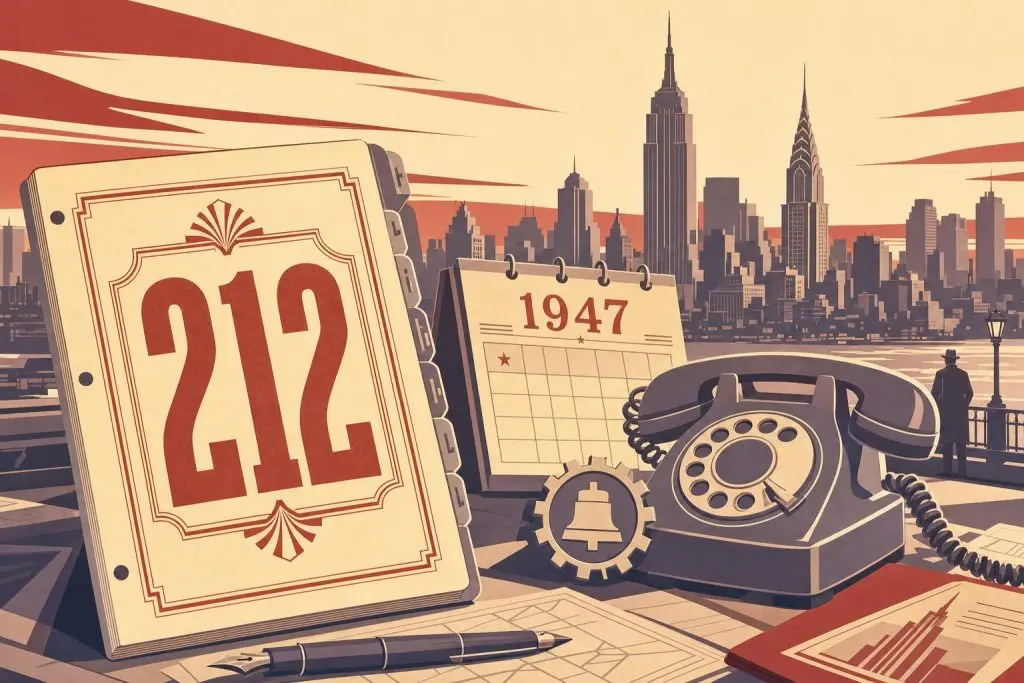
The history of area code 212 begins in 1947, when it was assigned to Manhattan, New York City as one of the original 86 area codes created when the North American Numbering Plan first carved up the continent. It is also one of the most coveted three-digit prefixes in the world, a small piece of New York City that travels with whoever owns the number. This post walks through how 212 came to be, how it shrank to just Manhattan, and why it still carries weight today. You can read more about how area codes are assigned from the North American Numbering Plan Administrator.
On this page
The History of Area Code 212: Where It Came From
When AT&T and the Bell System rolled out the North American Numbering Plan in 1947, the goal was to make long-distance dialing work without an operator. Engineers carved the United States, Canada, and parts of the Caribbean into 86 geographic zones, each assigned a three-digit prefix. New York City — already the largest and most economically important city in the country — got 212.
The early area code assignments followed a quiet engineering logic. The middle digit was always a 1 or a 0 to distinguish area codes from local exchange codes. Within that constraint, the codes that were easiest and fastest to dial on rotary phones went to the busiest cities. Numbers like 2 and 1 require less rotation of the dial than 8 or 9, so 212 was deliberately fast to call. New York’s status as a communications hub made that a meaningful design choice in an era when every long-distance call passed through a mechanical switch.
At the time, 212 covered all five boroughs: Manhattan, Brooklyn, Queens, the Bronx, and Staten Island. For nearly four decades, every phone in New York City carried the same area code.
Ready to Get a 212 Number?
One-time fee. No monthly charges. Port to any carrier in 3–5 business days. NYC's most trusted source since 2009.
Browse 212 Numbers →The 1984 and 1992 Splits That Shrank 212 to Manhattan
By the early 1980s, New York City was running through phone numbers faster than any other region in the country. Fax machines, dedicated business lines, second household lines, and the early wave of pagers and car phones all consumed numbers from the same pool. In 1984, the regional Bell company split the city: Manhattan and the Bronx kept 212, while Brooklyn, Queens, and Staten Island moved to a new area code, 718.
The split was not popular. Residents and businesses in the outer boroughs objected to losing the cultural shorthand that 212 had become, but the math was unavoidable. The reprieve, however, was short-lived. In 1992, the Bronx itself moved to 718, leaving 212 as the exclusive area code for Manhattan and a few small slices of the surrounding waterways. From that point forward, a 212 number meant Manhattan — and only Manhattan.
By the late 1990s, even the geographically constrained 212 pool was nearly exhausted, and in 1999 area code 646 was added as Manhattan’s own overlay.
The Overlays — 646, 917, and 332
Rather than splitting Manhattan again, regulators chose a different solution: overlays. An overlay assigns a second (or third, or fourth) area code to the same geographic territory, so existing numbers keep their original prefix while new lines draw from the additional pool. The trade-off is that ten-digit dialing becomes mandatory — you cannot dial a Manhattan number with seven digits alone, because the network has no way to know which area code you meant.
The first overlay arrived in 1992, when area code 917 was introduced to cover wireless phones and pagers across all of New York City. In 1999, area code 646 joined as a Manhattan-specific overlay. And in 2017, area code 332 was added as a third overlay when 212 and 646 were both nearing exhaustion again. New York City’s newest code, area code 465, was switched on in June 2026 — but it covers the Bronx, Brooklyn, Queens, Staten Island, and Marble Hill, not Manhattan.
All of these area codes are functionally interchangeable for dialing purposes. A 212 number, a 646 number, and a 332 number all ring phones in the same borough. But to most New Yorkers — and to most of the rest of the world — only one of them sounds like Manhattan.
Why 212 Still Carries Weight
The cultural cachet of 212 is the part that surprises people who didn’t grow up with it. After the 1984 split, the area code became a quiet status marker. A 212 number signaled that you (or your business) had been in Manhattan long enough to predate the overlays — or that you knew enough to acquire one when the chance came.
Television and film amplified the association. Movies set in New York used 212 numbers as shorthand for “the real Manhattan.” Madison Avenue advertising agencies, midtown law firms, and downtown finance shops all clung to their 212 lines through every wave of corporate moves. By the mid-2000s, tech founders in Silicon Alley were paying real money to acquire 212 numbers as a credibility signal — the digital-era equivalent of a Park Avenue address.
That demand has not faded. If anything, the scarcity has intensified. Once a 212 number is released back to the carrier pool, it rarely sits idle for long. The numbers that come back into circulation tend to be acquired quickly by businesses that understand what the prefix communicates.
Getting a 212 Number Today
You do not have to live in Manhattan — or anywhere near it — to own a 212 number. Modern wireless and VoIP networks decouple the number from the physical location of the phone, so a 212 line can ring on a cell phone in Los Angeles, a softphone in London, or a home office in Texas. Porting a 212 number to your existing carrier keeps the number working on your current device with no second phone required.
The mechanics are simple. You acquire the number, hand the porting information from My Numbers to your carrier (Verizon, AT&T, T-Mobile, or any major MVNO), and the transfer to your line usually completes in 3–5 business days. From that point forward, your phone rings as a Manhattan number, regardless of where you actually are.
Browse current inventory to see what’s available right now. Pricing starts From $150, with higher tiers for vanity patterns and memorable digit sequences. Call us at (212) 580-2000 if you’d like help selecting a number or have questions about porting.
Frequently Asked Questions
When was area code 212 created?
Area code 212 was assigned to New York City in 1947 as part of the original North American Numbering Plan rollout. It was one of 86 area codes created that year and one of the first ever dialed without operator assistance.
What area does 212 cover today?
Area code 212 covers Manhattan. The outer boroughs of New York City — Brooklyn, Queens, Staten Island, and the Bronx — are served by other area codes, primarily 718, 347, and 929.
Why is 212 considered prestigious?
After the 1984 and 1992 splits moved the outer boroughs to 718, a 212 number became a signal of Manhattan tenure. The cultural association deepened through decades of films, television, and media coverage of the city’s business and creative industries, and it persists today.
How many area codes does Manhattan have?
Manhattan has three area codes of its own: 212, 646, and 332. The 917 area code also covers Manhattan as part of its citywide overlay. New York City’s newest code, 465, covers the other four boroughs, not Manhattan. See our overview of Manhattan’s area codes for the full breakdown.
Are 212 numbers still available?
Yes, but inventory is limited and turns over quickly. New 212 numbers come back into circulation through carrier releases and customer transfers. See our current availability page for the latest status.
Can I get a 212 number if I don’t live in Manhattan?
Yes. Phone numbers are not tied to a physical address on modern wireless or VoIP networks. A 212 number can be ported to any major US wireless carrier and used on a cell phone anywhere in the world.
Is dialing the area code required for local Manhattan calls?
Yes. Since the introduction of overlay area codes, ten-digit dialing is mandatory within Manhattan — you must dial 212, 646, 332, or 917 even when calling another Manhattan number from a Manhattan line.
What was the first area code in the United States?
The first 86 area codes were assigned simultaneously in 1947, so technically there was no single “first.” However, 201 (New Jersey) was the first code actually used in a test call, and 212 was among the earliest in regular use due to New York City’s call volume.
