

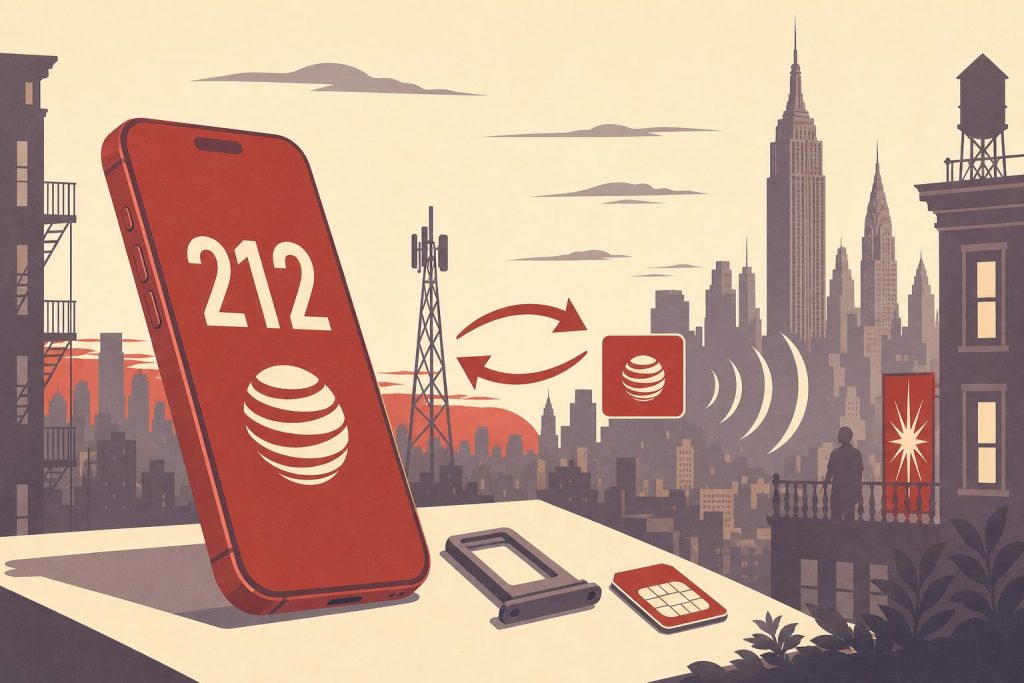
As the original smartphone, the iPhone has only increased in popularity through the years. Every new version of the device is more intuitively designed than the last. If you like having 4G service on your iPhone, you have to go with AT&T. Pairing your iPhone with an ultra-cool 212 phone number is also a lot easier than you may think. 212 numbers are available for purchase at 212areacode.com, and porting a 212 number to AT&T Wireless is a breeze.
The Best of Everything
When you combine the latest iPhone with 4G service and a 212 number, you really can have it all. No matter what number was assigned to you through your service provider, you can replace it with a 212 number without a lot of hassle. Before you do that, you’ll need to buy the number and the iPhone. From there, quick and easy steps for completing the process are available online.
Porting a 212 area cod ephone number can be done to Post-paid and prepaid accounts
Click here to check if a number is eligible to be ported to AT&T: http://www.wireless.att.com/cell-phone-service/transfer-your-number/
For more info on porting numbers to AT&T: http://www.wireless.att.com/cell-phone-service/transfer-your-number/#q1
Ready to Get a 212 Number?
One-time fee. No monthly charges. Port to any carrier in 3–5 business days. NYC's most trusted source since 2009.
Browse 212 Numbers →
Pairing a Manhattan 212 area code with AT&T Wireless is a routine port that usually completes in a few hours, not days. This guide walks through how to buy a 212 number, how AT&T handles the port-in, what information you need to gather first, and how the process differs slightly for postpaid lines, prepaid lines, and Cricket Wireless (which runs on AT&T’s network).
Why AT&T Works Well for a 212 Number
AT&T is one of the three nationwide facilities-based wireless carriers in the US, alongside Verizon and T-Mobile. Its network covers all of Manhattan with 5G, which matters because every 212 number is anchored to the Manhattan rate center. A receiving carrier has to confirm coverage in the originating rate center before a port clears, and AT&T’s Manhattan footprint makes that a formality.
AT&T also supports eSIM on every current iPhone and on most modern Android flagships. Since US iPhones have been eSIM-only since the iPhone 14 in 2022, the activation step for a ported-in 212 number is typically a QR code or in-app provisioning rather than a physical SIM swap. That removes a step that used to add a day or two to the process.
The practical upshot: a 212 number ported into AT&T behaves identically to a number AT&T issued you directly. You get full network coverage, full feature support (Wi-Fi calling, VoLTE, RCS messaging, visual voicemail), and full eligibility for whatever plan tier you’re on.
What “Porting” Means in Practice
Porting is the regulated transfer of a phone number from one carrier to another without changing the digits. The FCC requires every carrier to honor port requests, and a simple wireless-to-wireless port must complete within one business day. In practice, wireless-to-wireless ports — including ports into AT&T — usually finish in two to four hours when the paperwork is clean.
The number itself doesn’t physically move. What changes is a routing record in a national database that tells the global phone network which carrier owns your number today. The handoff happens in milliseconds, which is why ports flip so quickly once the verification step clears.
For a 212 number being moved to AT&T, the source carrier is whoever currently hosts the number. If you bought your 212 number from us, that source carrier is on our side, and the information AT&T needs is delivered with your order. If you already own a 212 number on another wireless carrier, VoIP service, or landline, the source is that provider and you’ll need to pull a few details from their account.
What You’ll Need Before Starting
AT&T asks for the same five pieces of information every US carrier asks for. Having all of these correct before you start is the single biggest factor in whether the port goes smoothly.
The 212 number being ported. All ten digits.
The account number on your current carrier. Not your AT&T account — the one you’re leaving. For a wireless source it’s on your most recent bill or in the source carrier’s app.
A transfer PIN from the source carrier. Most wireless carriers — including T-Mobile, Verizon, and AT&T itself — now require a short-lived transfer PIN that you generate inside the source carrier’s app right before starting the port. These typically expire in 24 hours. Don’t generate it days in advance and don’t try to use your old voicemail PIN; both will cause the port to reject.
The billing name and address on the source account. This has to match the source carrier’s records exactly. “Robert” and “Bob” are different to the automated system. Pull these directly from a recent bill.
The destination device. For most current iPhones and Android phones, this is just the device you’re already using on AT&T or the new device you’re activating. AT&T will provision an eSIM profile during the port for eSIM-capable hardware.
If you bought your 212 number from our shop, the source-side fields are included in your order confirmation. You hand them to AT&T at the porting step and the rest is on them.
How to Port a 212 Number to AT&T — Step by Step
You initiate the port through AT&T, not through your old carrier. Do not cancel service at the old carrier before the port completes — that releases the number back into the carrier’s general inventory and you lose the right to move it.
Step 1 — Buy your 212 number first. If you don’t already own one, browse current inventory and pick a number. Pricing starts From $150. Your purchase confirmation includes the source-carrier information AT&T will request at port-in.
Step 2 — Generate your transfer PIN. Log into your current carrier’s app and request a number transfer PIN. T-Mobile, Verizon, and AT&T all support this in-app. If your current carrier is a VoIP provider (Google Voice, Vonage, RingCentral), follow that provider’s port-out instructions instead — VoIP services use account-level authorization rather than a PIN.
Step 3 — Start the AT&T transfer. You can initiate the port at an AT&T retail store, by calling AT&T, or online during a new-line activation. AT&T will ask for the five fields above and read them back to confirm. Listen carefully here — a single transposed digit in the source account number is the most common cause of port rejections.
Step 4 — Leave your old service active. Your number stays on the source carrier until the moment the port flips. If you cancel early, the number is released and AT&T cannot pull it. Once the port completes, your old line deactivates automatically for that number.
Step 5 — Wait for the activation signal. Most wireless-to-wireless ports into AT&T flip within a few hours. You’ll know the port is done when calls to your number ring your AT&T device and your old device shows “no service” or “SIM not provisioned.” Make a test call from a different phone to confirm.
Step 6 — Set up voicemail and verify messaging. Voicemail does not transfer between carriers. Set up your AT&T voicemail greeting, then send and receive a few test texts — especially group texts that mix iMessage and non-iMessage participants. If anything is off, AT&T’s port team can usually correct it the same day.
Postpaid, Prepaid, and Cricket Wireless
AT&T offers postpaid wireless plans (billed monthly after use), AT&T Prepaid (paid up front, no credit check), and operates Cricket Wireless as an AT&T-owned prepaid brand running on the same AT&T network. All three accept port-in for 212 numbers, but the timing and details differ slightly.
AT&T postpaid. The standard wireless-to-wireless path. Ports typically complete in two to four hours during business hours. Eligible for all current AT&T plans, including the unlimited tiers that are now the default at all three major US carriers.
AT&T Prepaid. Same network, no credit check, paid in advance. The FCC allows up to 24 hours for prepaid ports rather than the standard 2.5-hour postpaid window, though in practice they often finish just as quickly. You’ll need an active prepaid plan in place at the time the port completes for the number to land.
Cricket Wireless. Cricket has been an AT&T-owned MVNO since 2014 and runs on AT&T’s network. Porting a 212 number to Cricket follows the same five-field process and uses the AT&T underlying infrastructure, so coverage in Manhattan is identical. For a deeper walk-through specific to Cricket, see our Cricket 212 Area Code Phone Number guide.
If you’re trying to decide between AT&T postpaid and Cricket for your 212 number, the practical tradeoffs are about plan features and device financing rather than the port itself — the port works identically on both.
eSIM Activation With a Ported 212 Number
If your destination device is a current iPhone (iPhone 14 or newer in the US, which are eSIM-only) or a newer Android with eSIM support, AT&T provisions the eSIM during the port rather than mailing a physical SIM card. The activation typically happens through a QR code AT&T sends you, through the myAT&T app, or — on iPhones — through the built-in eSIM transfer flow during setup.
The 212 number itself is unaffected by the SIM format. eSIM versus physical SIM is purely a question of how the device authenticates to AT&T’s network; the number that rings the device is the same either way. If you’re moving a 212 number from a physical-SIM device to an eSIM device or vice versa, the port handles the swap transparently.
For a fuller treatment of eSIM mechanics, see our guide on using an eSIM with a 212 area code phone number.
What Can Go Wrong
Most port-in failures fall into a small set of avoidable categories.
The most common is a name or address mismatch between what you give AT&T and what your source carrier has on file. Pull the exact strings from your most recent bill — don’t shorten “Robert” to “Bob” or “Avenue” to “Ave” if the bill uses the full form.
Second is an expired transfer PIN. The PINs are short-lived for security reasons. If you generated it days before starting the port, regenerate a fresh one.
Third is an active hold on the source line: an unpaid device installment plan, a fraud flag, or a contract lock. AT&T cannot bypass these; the source carrier has to release them. Call your old carrier and explicitly ask whether any port restrictions exist on the line.
Fourth is canceling old service too early. The port requires an active number on the source side. Let the port finish first.
None of these are AT&T-specific — they’re the standard set of port-rejection causes across all US carriers.
Frequently Asked Questions
Can I port any 212 number to AT&T?
Yes. AT&T covers Manhattan, which is where all 212 numbers are anchored, so the rate-center coverage check is automatic. Both postpaid and prepaid AT&T lines accept 212 port-ins, as does Cricket Wireless on the same network.
How long does it take?
Wireless-to-wireless ports into AT&T usually complete in two to four hours during business hours. The FCC requires simple ports to finish within one business day. Prepaid ports may take up to 24 hours but often finish faster. Landline-to-wireless and VoIP-to-wireless ports take longer — generally three to five business days.
Will I lose service during the port?
No. Your 212 number stays active on the source carrier until the moment the port flips, and then it’s active on AT&T. The total gap is usually under a minute. Calls during that window typically queue and ring through once the AT&T line is live.
Does AT&T charge to port a number in?
The FCC prohibits source carriers from charging a release fee. AT&T may charge a standard activation or SIM fee on the new line, but that’s separate from the port itself and is often waived during promotions. Ask before activating.
Where do I get the transfer PIN from my old carrier?
From the source carrier’s app. T-Mobile, Verizon, AT&T, and most major MVNOs let you generate a short-lived port-out PIN in-app. Older voicemail or account PINs no longer work for porting at the major carriers.
Can I port a 212 number to AT&T Prepaid or Cricket?
Yes to both. AT&T Prepaid is the AT&T-branded prepaid product, and Cricket is the AT&T-owned MVNO. Both run on AT&T’s network and both accept 212 port-ins. The five-field information requirement is identical.
Can I keep my old phone during the port?
Yes. Your old phone stays on the source carrier until the port flips, at which point that line deactivates for the 212 number. The physical device still works for Wi-Fi-only features and could be reactivated on a different number later if you wanted.
What if I have an installment plan or contract on the old line?
The port itself is not blocked, but the financial obligations don’t go away. You’ll still owe any remaining device payments and any early termination fees from your old carrier. AT&T occasionally runs “switch and save” promotions that credit some or all of that balance — worth asking about during signup.
Can I port the 212 number back out later if I change carriers?
Yes. Once the number is on AT&T, you can port it again — to another carrier or back to the original — at any time. There’s no FCC-required waiting period, though carriers may impose short internal hold periods to prevent fraud.
What about voicemails and texts from the old line?
Voicemails on the source carrier do not transfer. Save anything you want to keep before the port — most carriers let you forward voicemails to email. SMS history stays on the old device; iMessage history syncs through iCloud if you have that enabled.
Ready to Get Your 212 Number on AT&T?
Every 212 number in our shop is already provisioned on a cell-capable line, which means the port to AT&T is the simple wireless-to-wireless path — typically a few hours, often same-day. Pricing starts From $150 depending on the digit pattern.
Browse current inventory to see what’s available, or call us at (212) 580-2000 if you’d like help picking a number or have questions about the AT&T porting process.
