
Not every unfamiliar area code is a scam, but a handful of them show up in caller-ID windows again and again as the leading edge of robocalls, callback fraud, and premium-rate billing traps. Knowing which ones to think twice about — and which ones look foreign but are actually legitimate US numbers — saves both money and the irritation of being tricked into a return call. This guide covers the area codes that consistently get flagged, why they get flagged, and what to do when one lights up your phone.
Why Certain Area Codes Get a Bad Reputation
Every phone number in the US, Canada, and most of the Caribbean shares the same three-digit format because all of those countries sit inside the North American Numbering Plan (NANP). A number from Antigua dials exactly like a number from Atlanta — both start with +1 and both use a three-digit area code. That single design choice is the root of most “scam area code” lists.
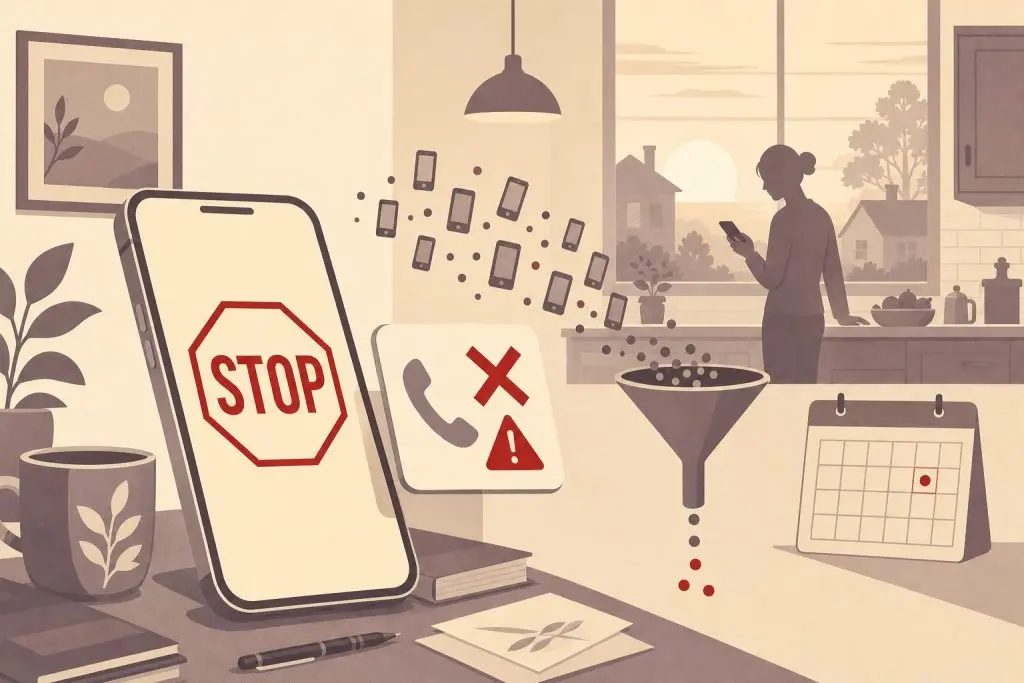
Robocallers and overseas fraud operations exploit the NANP overlap in two main ways. The first is the one-ring scam, sometimes called Wangiri (Japanese for “one ring and cut”). An automated dialer calls thousands of US wireless numbers, lets each one ring exactly once, then hangs up. The hope is that the recipient, curious or worried, calls back. Because the originating number is in a Caribbean country with premium-rate billing arrangements, the return call can get billed at international per-minute rates that the caller never agreed to — sometimes $20 or more for a few seconds of connection.
The second is traffic pumping, which is a US-domestic problem. A small rural local-exchange carrier with unusually high interconnection rates partners with a high-volume service — chat lines, free conference bridges, adult content — and shares the access fees that long-distance carriers are required to pay when calls terminate on its network. The end user doesn’t get billed directly, but the practice has been the subject of multiple FCC enforcement actions.
Caribbean Area Codes Most Commonly Used for Wangiri Scams
None of these area codes are inherently bad — millions of people live in these places and use these numbers legitimately. The problem is volume: the same handful of NANP-Caribbean area codes account for a disproportionate share of one-ring callback scams reported to US carriers and the FTC each year. If you don’t have a personal or business reason to expect a call from one of these places, treat an unfamiliar incoming call from them with extra caution.
Ready to Get a 212 Number?
One-time fee. No monthly charges. Port to any carrier in 3–5 business days. NYC's most trusted source since 2009.
Browse 212 Numbers →- 242 — Bahamas
- 246 — Barbados
- 268 — Antigua and Barbuda
- 284 — British Virgin Islands
- 345 — Cayman Islands
- 441 — Bermuda
- 473 — Grenada, Carriacou, and Petite Martinique
- 649 — Turks and Caicos Islands
- 664 — Montserrat
- 721 — Sint Maarten
- 758 — Saint Lucia
- 767 — Commonwealth of Dominica
- 784 — Saint Vincent and the Grenadines
- 809 / 829 / 849 — Dominican Republic
- 868 — Trinidad and Tobago
- 869 — Saint Kitts and Nevis
- 876 — Jamaica
The shorthand to remember: if a +1 area code starts with a digit pair that doesn’t match a US state or Canadian province you know, look it up before calling back.
US Area Codes Linked to Traffic Pumping
Traffic pumping is regional and tied to a handful of rural exchanges with elevated interconnection rates. Calls placed to numbers in these area codes aren’t dangerous to receive — the scheme works the other way, by inflating the volume of calls placed into them. The FCC has cited two area codes repeatedly in enforcement actions:
- 218 — northern Minnesota
- 712 — western Iowa
You’re unlikely to be billed personally for calls to a traffic-pumping number from a modern unlimited plan, but if you’ve been added to a conference bridge or chat service that prompted you to dial a 218 or 712 number, the conference operator is the one collecting on the back end.
Area Codes That Look Suspicious But Aren’t
A common mistake is flagging legitimate US area codes as scammy just because they’re unfamiliar. New York City alone has six active geographic area codes — 212, 332, 347, 646, 718, 917, and the newer 929 — and overlay codes like 332 in Manhattan or 929 across the boroughs frequently confuse callers used to seeing only 212 or 718. For context on how the city’s numbering evolved, see our post on New York City area codes 212, 646, and 332.
The same applies to overlay area codes nationwide. When the original area code in a region runs out of available number blocks, the FCC assigns an overlay code that covers the same geography. Los Angeles, Chicago, Dallas, Houston, and most major metros now have two, three, or four area codes serving the same neighborhoods. An unfamiliar code isn’t a fraud signal on its own — it’s usually just newer.
If you’re trying to evaluate whether a number is worth answering or returning, check the area code against a public NANP lookup before assuming the worst. Why the right area code matters covers why some codes carry trust and recognition while newer overlays take time to earn the same recognition.
How to Tell if a +1 Number Is Actually International
The trick that makes Wangiri work is that NANP-Caribbean numbers don’t carry the +1-242 or +1-876 prefix you’d expect from a “true” international call. They display in your caller ID exactly the way a Florida or California number would. There’s no flag, no country code prompt, no extra dialing required to call them back.
Two habits prevent almost all callback scams. First, if a number rings once and disconnects, never call it back without identifying it. A quick search of the ten digits in any search engine will usually return enough information to know whether the area code is domestic, Caribbean, or known-spam. Second, ask your carrier to enable international call blocking on your line if you don’t make international calls. T-Mobile, Verizon, AT&T, and major MVNOs all offer this — sometimes as a default in their spam-protection apps, sometimes as an opt-in. Blocking outbound international calls won’t affect your normal US service, and it makes a callback scam impossible to complete by mistake.
Don’t Be a Victim — Practical Tips for 2026
Phone fraud has gotten more sophisticated, but the defenses have caught up. A few habits go a long way:
Use your carrier’s built-in spam filter. Every major US carrier now ships a spam-screening app or feature — Verizon Call Filter, AT&T ActiveArmor, T-Mobile Scam Shield. They all use the same underlying STIR/SHAKEN caller-ID authentication framework the FCC has required since 2021, and they flag known robocalls before your phone even rings. Turn the free tier on; the paid tier is optional.
Don’t return calls to numbers you don’t recognize. If the caller is legitimate, they’ll leave a voicemail. If they don’t, they probably weren’t a real call in the first place. This single habit defeats every one-ring scam.
Verify the area code before calling back any unfamiliar number. The three Dominican Republic codes (809, 829, 849) and the Jamaica code (876) are the most common Wangiri origins reported to the FTC. A two-second lookup is cheaper than a $30 phone bill surprise.
Ask your carrier to block outbound international calls if you don’t need them. The block is reversible and doesn’t affect inbound calls, texts, or US/Canada calling. It just means a callback scam can’t actually connect.
Report scam calls. The FTC’s Report Fraud portal collects this data and uses it to push enforcement against persistent operations. It takes a minute and helps the next person.
Frequently Asked Questions
What is the most common scam area code?
The three Dominican Republic area codes — 809, 829, and 849 — appear most often in Wangiri one-ring callback complaints submitted to the FTC and major US carriers. Jamaica’s 876 and the British Virgin Islands’ 284 round out the top of the list. None of these are scam area codes in themselves; they’re simply the most frequently spoofed or used as Wangiri origins.
Will I really get charged for calling back a Caribbean area code?
You can, if the destination number is configured as a premium-rate line and your wireless plan permits international long distance. Charges of $5 to $30 for a brief call have been reported. The risk is concrete enough that the FCC and FTC have both issued public consumer alerts about one-ring scams.
Are the area codes 332, 347, 646, and 929 scam codes?
No. These are legitimate New York City overlay area codes covering the same geography as 212 and 718. They came into service as the original codes filled up. An unfamiliar overlay code isn’t a fraud signal — it usually just means the number is newer than the area’s original assignment.
Why do scam calls show up with US area codes?
Spoofing. The technology that displays caller ID can be manipulated to show any ten-digit number the caller chooses. Scammers commonly use “neighbor spoofing” — picking an area code and prefix close to the recipient’s own number to increase pickup rates. The STIR/SHAKEN framework the FCC mandated in 2021 has reduced this, but it hasn’t eliminated it.
How do I block all international calls on my phone?
Call your carrier or use your account dashboard to enable international call restriction. The exact path differs by carrier — Verizon and AT&T offer it through their account app, T-Mobile through Scam Shield or by request. The block is free and reversible.
Is 218 or 712 dangerous to receive calls from?
No. Traffic pumping works by inflating call volume into those rural exchanges, not by victimizing the recipient. If you’re getting calls from 218 or 712, they’re either legitimate (people live and work in northern Minnesota and western Iowa) or robocalls — neither of which costs you money to ignore.
How can I tell if a number is in the North American Numbering Plan but actually overseas?
A free NANP area-code lookup will tell you immediately. The digits 242, 246, 264, 268, 284, 340, 345, 441, 473, 649, 664, 670, 671, 684, 721, 758, 767, 784, 787, 809, 829, 849, 868, 869, 876, and 939 all share the +1 dialing prefix but sit outside the US and Canada.
Does my carrier’s spam filter catch Caribbean callback scams?
Modern carrier spam filters catch most known Wangiri origin numbers, especially once a number has been reported by enough subscribers. New numbers in the rotation may slip through for a day or two before they’re flagged. Your own habits — not calling back unknown numbers, blocking outbound international calls — are the more reliable defense.
Looking for a 212 Number You Can Actually Trust?
While unfamiliar area codes can mean trouble, a recognized Manhattan 212 number does the opposite — it signals a real, established presence that recipients are comfortable answering. Every number in our shop is a legitimate, properly assigned NANP number anchored to Manhattan, with pricing From $150 depending on the digit pattern.
Browse current inventory to see what’s available, or call us at (212) 580-2000 with questions about any number on the list.
