
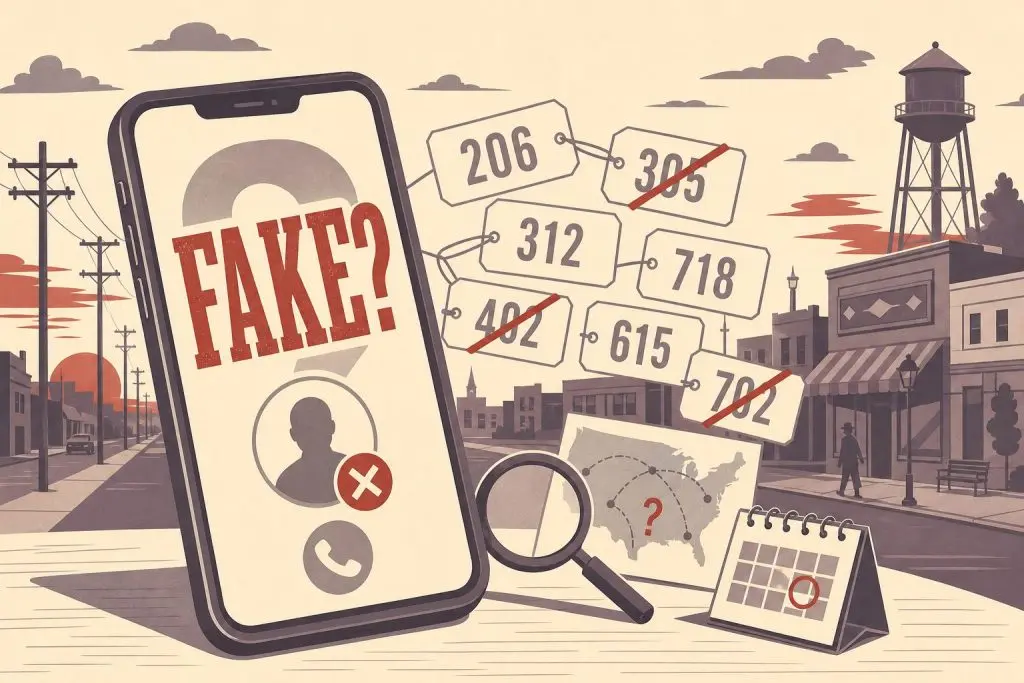
No US area code is fake. The North American Numbering Plan only assigns real, working area codes — and the ones that look unfamiliar are almost always either newer overlays you haven’t seen before or numbers that have been spoofed to display something other than the caller’s real line. This guide explains what people actually mean when they ask about “fake” area codes, which numbers genuinely don’t exist, and how to tell a spoofed call from a legitimate one.
No US Area Code Is Actually Fake
Every three-digit area code currently in service in the United States is assigned by the North American Numbering Plan Administrator (NANPA) and corresponds to a real geographic region or a real service type (toll-free, premium, non-geographic). The system has been in place since 1947, and codes are added, retired, or split as needed — but nothing about the structure allows for a “fake” code to exist on a real call.
What people usually mean when they ask whether an area code is fake is one of three things: the area code looks unfamiliar (often it’s a newer overlay like 332 in Manhattan or 929 in the outer boroughs), the caller ID displays something that doesn’t match where the caller actually is (that’s spoofing, not a fake code), or the number simply isn’t a valid NANP format at all (codes starting with 0 or 1, or codes that have never been assigned).
A small set of three-digit sequences are not valid area codes and never will be under current NANP rules. Numbers like 150, 200, 300, 75, or 8000 sometimes show up in search queries as “area codes,” but none of those are valid. Area codes are always three digits, the first digit is 2 through 9, and the second digit can be 0 through 9. Anything outside that pattern isn’t an area code at all.
What Caller ID Spoofing Actually Is
Spoofing is the practice of falsifying the number that appears on the recipient’s caller ID. Scam operations do this routinely because it makes their calls look local, trustworthy, or affiliated with a known business. The underlying call is still real and the underlying carrier is still real — only the displayed number is forged.
Ready to Get a 212 Number?
One-time fee. No monthly charges. Port to any carrier in 3–5 business days. NYC's most trusted source since 2009.
Browse 212 Numbers →Spoofing works because the caller ID field is set by the originating system, not validated by the network. For decades, that field was trusted at face value. A scam operation in another country can present a New York 212 number, a Washington DC 202 number, or any other code on your screen, and your phone has no way to know.
The FCC’s STIR/SHAKEN framework, now implemented across all major US carriers, was built to fix this. It attaches a cryptographic attestation to each call indicating whether the originating carrier verified the calling number. When attestation is missing or weak, modern carriers flag the call as “Scam Likely,” “Potential Spam,” or similar, which is why those labels have become much more common since 2021. The system isn’t perfect — small originating carriers and overseas gateways still leak through — but it has measurably reduced the volume of unlabeled spoofed calls.
Which Area Codes Get Spoofed Most
Any area code can be spoofed. There’s no special list that scammers favor exclusively, and reports on “most spoofed area codes” tend to track which legitimate area codes get falsified most often — not which codes are fake. The pattern usually reflects two things: large metropolitan codes with high resident populations (so the call looks plausibly local to many recipients), and codes associated with government or financial institutions (so the call looks authoritative).
Codes that frequently appear in spoofed-call reports include 202 (Washington DC, often used for fake IRS or Social Security calls), 212 and 646 (New York City, often used for fake bank or business calls), 305 and 786 (Miami), 310 (Los Angeles), 312 (Chicago), 832 and 214 (Texas metros), 407 (Orlando), and 702 (Las Vegas). None of those codes are fake. Real residents and real businesses use them every day. They just happen to be popular cover for scam traffic.
Treating a real area code as inherently suspicious does more harm than good. If you decline calls from 212 numbers because they’re “often spoofed,” you’ll miss legitimate Manhattan calls — and the same logic applies to every other major metro code on the list above.
The 8YY Range Is Real, Not Fake
Numbers in the 800, 833, 844, 855, 866, 877, and 888 ranges (collectively called 8YY or toll-free) sometimes get flagged as “fake” because they’re not tied to a specific city. They are real, valid, and assigned through the Somos toll-free database. Businesses use them so customers can call from anywhere in North America without paying long-distance charges.
The trade-off is that toll-free numbers are also the cheapest to obtain in bulk and are not geographically restricted, which makes them attractive cover for robocall operations. A toll-free number on your caller ID is not by itself a sign of fraud, but if the call is unsolicited and asks for personal information or payment, the same caution rules apply as with any other unknown number.
How to Tell a Spoofed Call From a Real One
You usually can’t tell visually. The whole point of spoofing is that the number on your screen looks legitimate. Reliable signals come from what happens after you answer or what your carrier flagged before the call rang.
Check the label on your screen. Modern carriers and operating systems display “Scam Likely,” “Spam Risk,” “Potential Fraud,” or a similar warning when STIR/SHAKEN attestation is weak or the number matches known spam patterns. Trust those labels — they’re built on industry-wide call analytics, not guesses.
Listen for the script. Legitimate businesses identify themselves, your account, and a reason for the call. Scam calls open with urgency (“your Social Security number has been suspended,” “press 1 to avoid arrest”), threats, or a request to verify personal information they should already have. Government agencies do not threaten arrest by phone. Banks do not ask you to read your card number aloud.
Hang up and call back through a number you trust. If a call claims to be from your bank, your carrier, the IRS, or any institution you have an account with, hang up and dial the number printed on your card, your bill, or the official website. Never call back the number that just called you, and never use a callback number the caller provides.
Do not press buttons or speak. Pressing 1 to “remove yourself from the list” or speaking the word “yes” can confirm to the scam operation that your line is live and worth calling again, and in some cases the audio is captured and reused. Silence and a hang-up are the safest response.
What to Do With a Suspicious Call
If a call gets through and you suspect it was a scam, the most useful steps take only a minute. Block the number through your phone’s settings (iPhone: tap the info icon next to the number in Recents and choose Block Caller; Android: long-press the number in your call log and choose Block). Blocking won’t stop the next spoofed call from a different number, but it ends contact from the specific line.
Report the call to the FTC at reportfraud.ftc.gov and, if it was a robocall, to the FCC at fcc.gov/consumers/guides/stop-unwanted-robocalls-and-texts. These reports feed into the call-analytics systems carriers use to label future calls, so reporting genuinely helps.
Register your number on the National Do Not Call Registry at donotcall.gov. The registry won’t stop scammers — they ignore it — but it will stop legitimate telemarketers, which makes the remaining unwanted calls easier to recognize as illegitimate. For more on screening practices, see our guide to blocking phone numbers on iPhone or blocking area codes on Android.
Frequently Asked Questions
Are there any fake US area codes?
No. Every area code in active service is assigned by the North American Numbering Plan Administrator and tied to a real region or service type. Sequences like 150, 200, 300, or 8000 are not area codes at all — area codes are three digits starting with 2 through 9.
Is 150 an area code?
No. Area codes start with 2 through 9, so 150 is not a valid area code anywhere in the North American Numbering Plan. If you see “150” in a number, it’s most likely part of a longer international format or a non-standard short code.
Is 200 an area code?
No. The NANP reserves codes starting with 0 and 1 for switching and signaling functions, so 200 has never been issued as an area code and will not be.
Is 8000 an area code?
No — area codes are three digits, not four. If a number on your caller ID looks like “8000-something,” the formatting is probably wrong on your screen. The real US toll-free range starts with 800, 833, 844, 855, 866, 877, and 888.
Why do scammers use 202, 212, or 786 area codes?
Because those codes look authoritative (202 is Washington DC, often impersonated by fake government calls) or look local to many people (212, 786, and other big metro codes). The codes themselves are real and used by millions of legitimate residents and businesses. Scammers spoof them to gain trust.
What are the most spoofed area codes in 2025 and 2026?
Industry call-analytics reports consistently flag 202, 212, 305, 310, 312, 404, 407, 469, 646, 702, 786, and 832 as among the most spoofed. These are large metropolitan or government-associated codes that scammers borrow to make calls look credible. Real residents and businesses in those areas are not the source.
How do I know if a 212 call is real?
Treat it like any other call: legitimate callers identify themselves and give a reason. If the call is from a business you have an account with, hang up and call back through the number on your statement or the company’s official website. A genuine 212 caller will not pressure you for personal information or payment on the spot.
Does the FCC’s STIR/SHAKEN framework stop spoofing entirely?
No, but it has reduced unlabeled spoofed traffic significantly. STIR/SHAKEN attaches a cryptographic attestation to each call so the recipient’s carrier can flag calls with missing or weak verification. Small originating carriers and overseas gateways still let some spoofed calls through, which is why “Scam Likely” labels still appear regularly.
What should I do if I answered a scam call?
Hang up immediately. Do not press any buttons, speak any words, or confirm any information. Block the number in your phone’s settings and report the call to the FTC at reportfraud.ftc.gov. If you gave the caller personal or financial information, contact your bank, change affected passwords, and consider placing a fraud alert with the credit bureaus.
Is a toll-free number (800, 888, etc.) a fake area code?
No. Toll-free numbers are real, valid, and assigned through the Somos database. They aren’t tied to a city because they’re designed for nationwide reach. Toll-free does not equal scam, but unsolicited toll-free calls deserve the same caution as any unknown number.
Want a Real Manhattan Number Instead of a Spoofed One?
The 212 area code is one of the most recognizable in the country, which is exactly why scammers spoof it. A real 212 number — one actually assigned to you, routable to your phone, and verifiable through STIR/SHAKEN — carries weight that no spoofed call can match. Pricing starts From $150 depending on the digit pattern.
Browse current inventory to see what’s available, or call us at (212) 580-2000 with questions about choosing the right number.
