

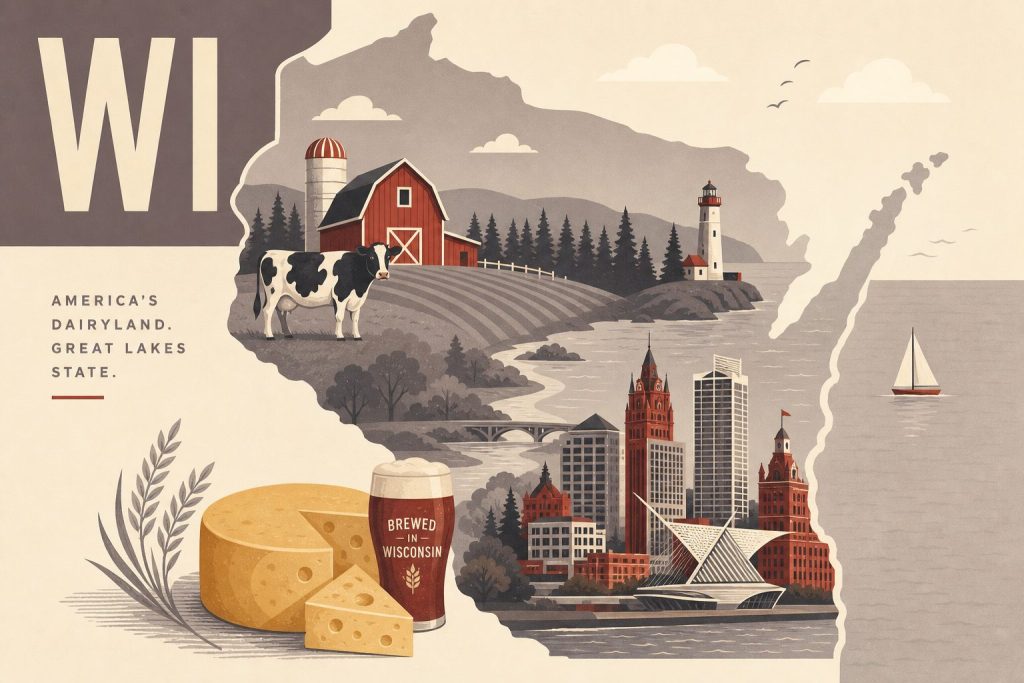
Wisconsin has 8 active area codes as of 2026, covering the state through a mix of original 1947 assignments, geographic splits, and modern overlays. This guide walks through the full list, which regions each code serves, the order they came online, and where new codes are most likely to land next.
The Short Answer
Wisconsin currently has 8 active area codes in service. The count reflects a combination of population growth, the rise of mobile lines, and the way modern numbering allocates blocks — every line activated, whether a cellphone, a business desk line, a VoIP number, or a connected device, consumes a slot in the pool.
By population, Wisconsin ranks #20 nationally with roughly 5,960,975 residents as of the most recent estimates. That puts the state’s area code count in line with its population peers — denser, faster-growing states need more codes; smaller states need fewer.
The Full List of Wisconsin Area Codes
The active area codes serving Wisconsin are listed below, in numerical order. Where a code is an overlay or a split-off from an earlier code, that relationship is noted.
- 262 — Southeastern Wisconsin (Waukesha, Racine, Kenosha)
- 274 — Eastern Wisconsin (Green Bay, the Fox Cities) (overlay of 920)
- 353 — Southwestern Wisconsin (Madison) (overlay of 608)
- 414 — Milwaukee County and immediate surroundings
- 534 — Northern Wisconsin (Eau Claire, Wausau, Superior) (overlay of 715)
- 608 — Southwestern Wisconsin (Madison, La Crosse)
- 715 — Northern Wisconsin (Eau Claire, Wausau, Superior)
- 920 — Eastern Wisconsin (Green Bay, the Fox Cities, Sheboygan, Manitowoc)
How Wisconsin’s Area Codes Grew Over Time
Wisconsin was assigned 2 area codes in the original 1947 NANP launch — 414, 715 — reflecting the state’s population and territorial size at the time. Subsequent splits and overlays have added codes as demand has grown.
Ready to Get a Wisconsin Number?
One-time fee. No monthly charges. Port to any carrier in 3–5 business days. NYC's most trusted source since 2009.
Browse Wisconsin Area Codes →- 1947 — 414 and 715 assigned as Wisconsin's two original area codes at the launch of the North American Numbering Plan. 414 covered the southern and eastern portions of the state including Milwaukee; 715 covered the northern part.
- 1955 — 608 split off from 414 for southwestern Wisconsin, including Madison and La Crosse.
- 1997 — 920 split off from 414 on July 26, covering eastern Wisconsin including Green Bay, the Fox Cities, Sheboygan, and Manitowoc.
- 1999 — 262 split off from 414 for southeastern Wisconsin, including Waukesha, Racine, and Kenosha, leaving 414 to serve Milwaukee County and its immediate surroundings.
- 2010 — 534 activated as an overlay of 715 across northern Wisconsin, the state's first overlay code.
- 2023 — 353 activated as an overlay of 608 in southwestern Wisconsin, and 274 activated on May 5 as an overlay of 920 in eastern Wisconsin.
Why Wisconsin Has Multiple Area Codes
A single area code can hold roughly 7.9 million possible phone numbers in theory — 792 valid central office codes (the second three digits) multiplied by 10,000 line numbers each. In practice the usable count is lower, because blocks of numbers are reserved, withheld, or assigned in bulk to carriers that may never fully use them. When the pool of available numbers in an area code falls below the threshold the North American Numbering Plan Administrator (NANPA) tracks, the state requests relief, and either a split or an overlay is approved.
Wisconsin’s population of roughly 5,960,975 residents would, on its own, fit comfortably inside a single area code’s capacity. The reason 8 codes are needed instead is that every adult typically carries at least one mobile line, many households have multiple lines per person, businesses concentrate phone numbers at extreme density, and connected devices, VoIP services, and second-line apps all draw from the same pool. The math compounds quickly.
Wisconsin Area Codes by Region
Milwaukee (414): Milwaukee County and several adjacent communities. 414 is one of Wisconsin's two original 1947 codes and now serves the most compact territory after successive splits carved off 920 and 262.
Southeastern Wisconsin (262): Waukesha, Racine, Kenosha, and the suburban ring around Milwaukee. Split off from 414 in 1999.
Southwestern Wisconsin (608, 353): Madison, La Crosse, and the southwestern counties. 608 split off from 414 in 1955; 353 overlay added in 2023.
Eastern Wisconsin (920, 274): Green Bay, the Fox Cities, Sheboygan, and Manitowoc. 920 split off from 414 in 1997; 274 overlay added in 2023.
Northern Wisconsin (715, 534): Eau Claire, Wausau, Superior, and the northern counties. 715 is one of the two original 1947 codes; 534 overlay added in 2010.
What’s Next for Wisconsin Area Codes
Wisconsin’s numbering pool has a long runway. The three geographic numbering plan areas with the most demand — 608 around Madison, 920 in the Fox Cities and Green Bay, and 715 across the north — each gained an all-services overlay (353, 274, and 534) that effectively doubled their available numbers. NANPA’s most recent NPA exhaust projections show no Wisconsin numbering plan area on the near-term relief schedule, and the Milwaukee-area 414 and 262 codes have not required additional relief since the 1999 split. The next pressure point, if any, is most likely the Madison area as Dane County continues to grow.
Frequently Asked Questions
How many area codes does Wisconsin have right now?
Wisconsin has 8 active area codes in service across the territory it covers, including any overlays that share geography with an older code.
What is the oldest area code in Wisconsin?
414 is the oldest active area code in Wisconsin, assigned in 1947 when the North American Numbering Plan launched. It remains in service today, though its geographic footprint has typically been reduced by subsequent splits and overlays.
What is the newest area code in Wisconsin?
The most recent area code addition to Wisconsin was 353, activated in 2023. New phone lines provisioned in its service area are increasingly drawn from this code as older overlays approach exhaustion.
Why does Wisconsin need so many area codes?
Population growth combined with the proliferation of mobile lines, business direct-dial numbers, VoIP services, and connected devices has exhausted older codes faster than the original 1947 plan anticipated. Each new area code adds roughly 7.9 million additional phone numbers to the regional pool.
Which area code covers Milwaukee?
Milwaukee is served by 414, one of Wisconsin’s two original area codes from 1947. After the 920 split in 1997 and the 262 split in 1999, 414 now covers Milwaukee County and a handful of immediately adjacent communities, making it the most geographically compact code in the state.
Which area code covers Madison?
Madison falls within 608, which split off from 414 in 1955 and serves southwestern Wisconsin. Since 2023 it has been paired with the 353 overlay, so new lines in the Madison area may be assigned either 608 or 353, and ten-digit dialing is required.
Is 534 a real Wisconsin area code?
Yes. 534 is an overlay of 715 covering northern Wisconsin, activated in 2010. It shares the same territory as 715 — Eau Claire, Wausau, Superior, and the surrounding counties — rather than carving out a separate region.
Why does eastern Wisconsin have two area codes?
Eastern Wisconsin uses 920 and 274. 920 split off from 414 in 1997 to serve Green Bay, the Fox Cities, Sheboygan, and Manitowoc. As numbers in that region ran low, 274 was added as an overlay on May 5, 2023, so both codes now cover the same area.
Ready to Get a Number in Wisconsin?
We carry available Wisconsin numbers right now across multiple area codes. Order directly in 262, 274, 353, 414, or 534 — a one-time fee, no monthly charges, with pricing From $150 depending on the digit pattern and memorability of the number. Prefer help choosing? Call us at (212) 580-2000.
Related Reading
- Illinois Area Codes: All 17 Active Codes, by Region (2026)
- Minnesota Area Codes: All 8 Active Codes by Region (2026)
- Michigan Area Codes: Complete List of 13 Active Codes (2026)
- 414 Area Code: Where It’s Used & How to Get One
- How Many Area Codes Are in the US
- What States Have the Most Area Codes
Compare this with area codes across all 50 states and territories.
