

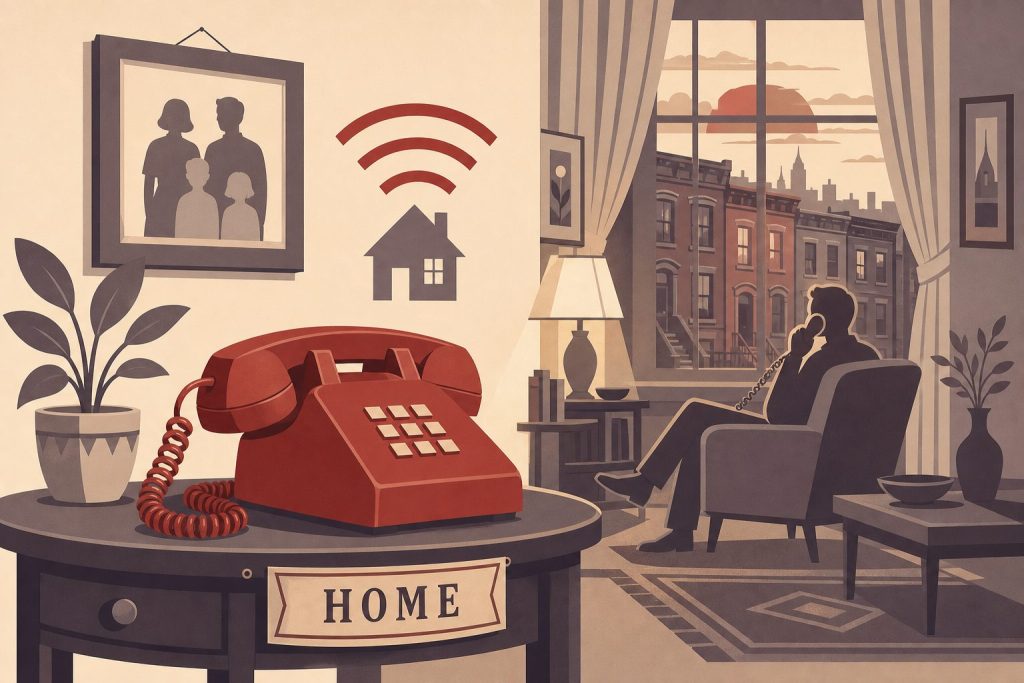
Landline phones were supposed to disappear a decade ago. Instead, sales are climbing again — driven by Gen Z buyers, work-from-home professionals tired of being on call, and households that want a phone that just rings when somebody calls. Here is what is actually behind the comeback in 2026, what a modern “landline” really looks like, and how a Manhattan 212 number fits the trend.
What a Landline Means in 2026
The word “landline” still conjures up an image of a copper wire running from a wall jack to a corded phone. That version exists, but it is no longer the default. Most new home phone lines in 2026 are delivered over either fiber-optic internet or cable broadband, with the phone plugging into a small adapter or router port instead of a dedicated copper pair. The user experience is the same — pick up the receiver, hear a dial tone, dial out — but the underlying technology has shifted.
Traditional copper service, called POTS (Plain Old Telephone Service), is being actively retired. The FCC approved the major carriers’ plans to wind down copper networks years ago, and Verizon, AT&T, and the regional Bell successors have spent the last decade migrating residential customers to fiber or wireless replacements. What people are buying when they say they want a “landline” today is usually one of three things: a fiber-based home phone line from Verizon Fios or AT&T Fiber, a cable phone line from Spectrum or Optimum, or a VoIP service running on whatever broadband they already have. All three behave like a landline from the user’s side. None of them runs on copper.
This matters because the comeback is not really about the wire. It is about the form factor and the social contract: a phone tied to a place, not a person, with a single ringer the whole household can hear, and a number that does not buzz in your pocket at midnight.
Privacy and the Boundary Problem
Cell phones removed every wall between work and the rest of life. A landline puts a wall back. The phone sits on a table. When you leave the room, the phone does not follow you. When you go to bed, you can ignore it without justifying the decision to anybody, including yourself.
Ready to Get a 212 Number?
One-time fee. No monthly charges. Port to any carrier in 3–5 business days. NYC's most trusted source since 2009.
Browse 212 Numbers →That sounds small. It is not. Survey after survey over the last few years has flagged the same pattern: younger adults report being unreachable as a feature, not a flaw. A landline makes “I was not by the phone” a true statement again. People who legitimately need you in an emergency — close family, a neighbor, your kid’s school — can have the number. Everybody else gets the cell.
The robocall situation reinforces this. Despite STIR/SHAKEN authentication and FCC enforcement, spam calls have not gone away. A landline used selectively, with the number kept off public forms and out of loyalty-program databases, can stay remarkably quiet. The same number printed on every shipping label and webform you have ever filled out cannot. Buying a fresh number — including a 212 — and using it only with people who actually need to reach you is a practical privacy move.
Call Quality and Reliability
Modern wireless calling is fine most of the time. It is not fine all of the time. In dense buildings, on the subway, in an elevator, during a thunderstorm — call quality drops, calls drop, voices clip. A wired or fiber-delivered home phone does not have those failure modes. The audio is full-bandwidth, there is no hand-off between cell towers, and the system was designed before “you broke up there, can you say that again” became a normal sentence.
Reliability during outages is more nuanced than it used to be. The old copper-line claim — that a landline keeps working even when the power goes out — was true because the copper wire itself carried enough current to power the handset, and the central office had its own backup power. Fiber and cable-based home phone lines need power for the modem and router at your house. They can stay up during a power outage only if you have a battery backup or a UPS on the modem. Some carriers ship a backup battery; many do not. If outage reliability is the reason you want a landline, ask the provider specifically about backup power before you sign up.
Where the reliability advantage still holds clearly is software. A home phone does not run apps, does not get OS updates that brick the dialer, does not need a SIM that occasionally needs reprovisioning. It dials. It rings. That predictability is the appeal.
Affordability and the Bundle Math
A modern home phone line is rarely sold standalone. It comes bundled with internet and sometimes TV, which puts the effective add-on cost in the range of a few dollars to a few tens of dollars per month depending on the provider. Spectrum, Optimum, Verizon Fios, AT&T, and the regional cable operators all sell phone-line add-ons in roughly this band. VoIP-only services — running on the broadband you already pay for — sit at the lower end and sometimes get into low-double-digit monthly territory or below.
For households running an unlimited cellular plan for every adult, adding a home line is not a cost-cutting move. It is a separation move: a phone for the house, a phone for the person. For multigenerational households, a shared landline is sometimes cheaper than adding an extra cell line, especially when the alternative is buying a phone for a kid who is not ready for one.
Small businesses run the same math the other direction. A dedicated business line — particularly a memorable 212 number — keeps customer calls separate from personal calls and gives the business a stable contact point that does not change when staff turns over. The phone hardware is cheap. The number is the asset.
Why People Are Pairing the Comeback With a 212 Number
The same people choosing to add a landline in 2026 tend to care about the number itself. If you are buying a phone that lives on a table and that you will keep for years, the digits matter. A Manhattan 212 number lands differently than a number from a recently-opened overlay code — it signals that the line has been around, that the person or business behind it has a presence, and that the call is worth picking up.
Because home phones are now delivered over fiber, cable, or VoIP, a 212 number is not geographically restricted. You can use it on a home line in Brooklyn, in Westchester, or in another state entirely, as long as you have a broadband connection. The number rings on whatever device you plug into the line. Porting between landline and cell is also fully supported under FCC rules, so a number you put on a home line today can move to a cell later, or vice versa, without changing the digits.
For businesses, the combination is especially clean: a 212 number on a VoIP-based business line gives you a Manhattan identity that rings on a desk phone, a softphone app, and a forwarded cell simultaneously. For residential customers, it gives you a fresh, low-spam line tied to one of the most recognizable area codes in the country.
Frequently Asked Questions
Are landline phones actually making a comeback?
Yes. Sales of home phone hardware have ticked up in recent years, and major retailers and consumer-electronics outlets have reported renewed interest from younger buyers in particular. The driver is less about nostalgia and more about wanting a phone that stays in one place and does not double as a work tether.
Is “landline” still the right word for a fiber or VoIP phone line?
Colloquially, yes — most people use “landline” to mean any home phone line tied to an address rather than a cell. Technically, a true landline runs over copper, and almost no new residential service is provisioned that way in 2026. Fiber-based, cable-based, and VoIP home phones all behave like landlines from the user’s side, even though the underlying technology is different.
Will a modern landline keep working during a power outage?
Only if the modem and router stay powered. Old copper lines drew power from the phone network itself. Fiber, cable, and VoIP lines need household power. A small UPS or a carrier-supplied battery backup on the modem is the simplest way to preserve outage reliability.
Can I put a 212 area code on a home phone line outside Manhattan?
Yes. Because most home phone service is now delivered over broadband, the number is not tied to a specific physical location. You can host a 212 number on a home line anywhere your broadband provider supports VoIP, fiber, or cable phone service. See how 212 numbers work across devices for more on this.
How much does a home phone line cost in 2026?
It depends on the provider and on whether the line is bundled with internet. Standalone VoIP services sit at the low end of the range; cable and fiber phone add-ons sit in the middle; legacy copper service, where it still exists, is usually the most expensive. Ask any provider for the bundled price next to the standalone price — the bundled rate is almost always cheaper.
Can I block unwanted calls on a landline?
Yes. Most modern home phones include built-in call-block lists, and many providers offer network-level call screening that filters known robocalls before the phone rings. Our guide on how to block a phone number on a landline phone walks through the most common methods.
Can I port my existing cell number to a new landline?
Yes. FCC rules require carriers to port numbers in either direction — wireless to landline or landline to wireless — as long as the receiving carrier serves the rate center the number is anchored to. The process is the same as any other port: you initiate it through the new carrier, not the old one.
Are Gen Z buyers really the ones bringing landlines back?
That is the most-cited trend, but it is not the only segment. Remote workers, parents of young kids, small business owners, and households that have been on the receiving end of a SIM-swap fraud attempt are all over-represented in the buyer pool. The common thread is wanting a phone that is harder to misuse or to lose, not a particular demographic.
Do I still need a cell phone if I get a landline?
For most people, yes. The point of a home phone in 2026 is rarely to replace the cell — it is to add a second, slower, more deliberate channel. A few households are unplugging from cell service entirely, but they are the exception. The typical buyer keeps both.
Ready to Pair the Comeback With a 212 Number?
If a landline is back on your shopping list and you want the number itself to mean something, a Manhattan 212 number is the cleanest signal you can pair it with. Browse current inventory — numbers start From $150 — or call us at (212) 580-2000 if you would like help matching a number to your setup.
