

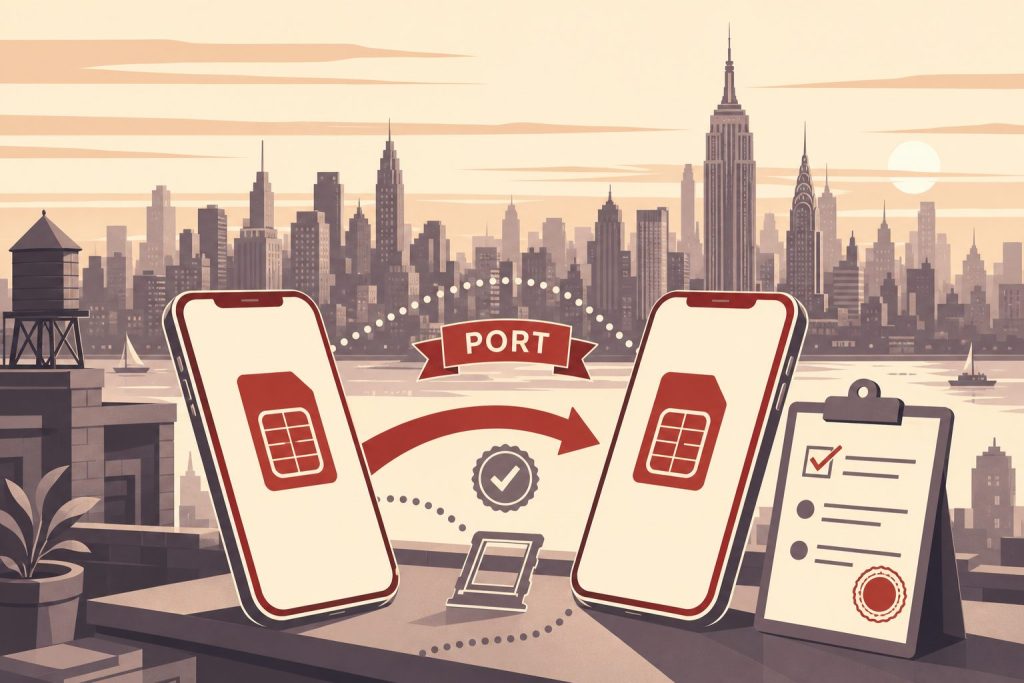
There’s a popular misconception that porting a 212 number to a cell phone is a long, arduous process. As a result, some people are reluctant to do it. In reality, though, porting a 212 number couldn’t be easier. In 95% of cases, the process is as simple as making a quick phone call to your cell phone provider. Since they handle such requests all the time, making the switch is a very basic thing for them to do. Although porting a number from a VoIP or land line generally takes longer, it’s still not a cumbersome experience.
When porting an old cell phone number to a new carrier, the process is as simple as providing a few key pieces of information. Typically, this information includes your name, address, account number and PIN. The new carrier needs this information to verify that you are authorized to make the switch. From there, all of the technical details are handled “behind the scenes” and your new number is seamlessly ported to your cell phone.
When it comes to porting a 212 number, the process is virtually identical. Since you’ll be porting a new number to a cell phone provider, you’ll still need all of the account-related information in order to make the switch. By purchasing a 212 number, you gain access to all of the information that you’ll need to switch that number to your cell phone provider. Before buying a 212 number, it’s never a bad idea to double-check with your specific provider about how they handle phone number porting. That way, you don’t have to worry about any unpleasant surprises.
If the 212 number that you’re buying used to belong to a land line or VoIP, the process may take a little longer. Different considerations have to be made in such instances; up to ten days may be needed for the switch to go into effect. Still, the end result will be the same: You’ll have a shiny new 212 phone number to show off. In the end, the process of porting that number will be more than worth it – and you’ll be glad that you did it!
All 212 area code phone numbers posted on our website are on cell phone lines, making it extremely easy to port any number to your cell phone even the same day!
Ready to Get a 212 Number?
One-time fee. No monthly charges. Port to any carrier in 3–5 business days. NYC's most trusted source since 2009.
Browse 212 Numbers →Porting a 212 area code number to a cell phone is far easier than most people assume. In most cases the work is paperwork on the new carrier’s end and you keep using your old number until the switch flips — usually within hours, not days. This guide walks through how the process actually works in 2026, what information you’ll need, how long each scenario takes, and the small mistakes that cause most porting delays.
What “Porting” Actually Means
Porting is the regulated process of moving a phone number from one carrier to another without changing the digits. The Federal Communications Commission codified this right in 1996 under wireless local number portability rules, and it applies to wireless, wireline, and VoIP services alike. Once you request the move, your old carrier is legally required to release the number, even if you have an outstanding balance with them (you’ll still owe that balance, but they cannot hold the number hostage).
The number itself doesn’t physically move. What changes is the routing record in a national database that tells the global phone network which carrier owns your number today. When someone dials your 212 number, the network looks up that record and routes the call to the right place. The lookup happens in milliseconds, which is why ports finish so quickly once the paperwork clears.
If you already own a 212 number on a landline or VoIP service and you want to move it to your cell phone, the process is a port. If you’re buying a 212 number from us and want it activated on your existing cell line, that’s also a port — just one where the source carrier is ours and the destination carrier is yours. Either way, the mechanics are the same.
How Long a Port Actually Takes
The honest answer is “it depends on the source,” but the ranges are tighter than most people expect.
Wireless to wireless (T-Mobile to Verizon, AT&T to Cricket, etc.) is the fastest path. The FCC requires simple ports to complete within one business day, and most wireless carriers process them in two to three hours when the paperwork is clean. We routinely see same-day completions for customers who submit their port request in the morning.
VoIP to wireless (Vonage, RingCentral, Google Voice to a cell line) typically takes one to three business days. VoIP providers run their own internal porting queues and the handoff to a wireless carrier involves a couple of extra verification steps. Nothing complicated — just slower.
Landline to wireless is the slowest scenario, generally three to five business days. The wireline-to-wireless handoff involves the rate center where the number originally lived (212 numbers are all anchored to Manhattan), and the receiving wireless carrier has to confirm coverage in that rate center before the port clears. Since every wireless carrier covers Manhattan, the coverage check is a formality, but it still has to happen.
If your port is taking longer than five business days, that’s a signal to follow up. Call your new carrier first and ask for the port status. If they confirm a stall and can’t resolve it, you can file a complaint with the FCC, which tracks carrier compliance with porting timelines.
What Information You’ll Need
Every port requires the same five pieces of information, and one missing or misspelled field is the single most common reason ports get delayed. Have all of this ready before you start:
The phone number being ported. All ten digits, including the 212 area code.
The account number on the source carrier. This is the account at the carrier you’re leaving — not your new carrier. For wireless, it’s usually on your bill or in your online account dashboard.
The account PIN or transfer PIN. Most wireless carriers now use a short-lived transfer PIN that you generate inside your account when you’re ready to port. T-Mobile, AT&T, and Verizon all let you generate this PIN online or via their app, and it usually expires in 24 hours. Generate it right before you start the port — not days in advance.
The billing name and address on the source account. This has to match the source carrier’s records exactly. If your account lists your full middle name and you give the new carrier just an initial, the port can reject. If you’ve moved recently, double-check that your old carrier has your old address (the one on the bill), not your new one.
The destination carrier and the device or SIM that will receive the number. For most modern phones this is just your iPhone or Android device. For eSIM phones, your new carrier will provision an eSIM profile during the port.
If you’re buying a 212 number from our shop, all the source-side information is delivered to you in your order so you can hand it directly to your new carrier. You don’t need to track down account numbers — they’re in your purchase receipt.
How to Port Your 212 Number — Step by Step
The actual process is straightforward, and you initiate it through your new carrier, not your old one. This is important: do not cancel service at your old carrier first. If you do, the number is released back to the carrier’s general inventory and you lose the right to port it.
Step 1 — Gather your information. Pull together the five fields listed above. If you’re moving from a wireless carrier, generate your transfer PIN through that carrier’s app or website right before you start. Don’t generate it days early; most expire quickly.
Step 2 — Contact your new carrier. You can do this in a retail store, by phone, or online during checkout if you’re activating a new line. Tell them you want to port a number in, and provide all five fields. They’ll typically read the information back to you to confirm spelling and digit accuracy — listen carefully here. A single transposed digit in your account number is the most common cause of rejections.
Step 3 — Keep your old service active. While the port is in flight, do not cancel your old carrier. Your number stays with them until the port completes, and canceling early can void the port. Once the port flips, your old service automatically deactivates for that number.
Step 4 — Wait for the activation signal. Most wireless-to-wireless ports flip within a few hours. You’ll know it’s done when calls to your number start ringing your new phone and your old phone shows “no service” or “SIM not provisioned.” Make a test call from another phone to confirm.
Step 5 — Set up voicemail and verify call quality. Your old voicemail does not transfer. Set up a new voicemail greeting on your new carrier, send and receive a few test texts (especially group texts if you’re moving between iMessage and non-iMessage devices), and confirm that incoming calls ring through. If anything is off, your new carrier’s port team can usually fix it the same day.
What Can Go Wrong (and How to Avoid It)
Most port failures fall into a handful of avoidable categories. Knowing what they are means you can dodge them.
The single biggest cause of port delays is a name or address mismatch between what you give your new carrier and what your old carrier has on file. If your old carrier knows you as “Robert” and you tell the new one “Bob,” the automated systems will reject the port and a human will have to intervene. Use the exact name and address from your most recent bill at the source carrier.
The second most common issue is an expired or wrong account PIN. Carriers used to allow the four-digit voicemail PIN to double as the porting PIN; most now require a separately generated transfer PIN. If you’re using an older PIN you set years ago, the port will reject. Always generate a fresh transfer PIN immediately before starting.
Third: active fraud holds or account locks on the source account. If you’ve had recent suspicious-activity flags, an outstanding device installment plan, or a contract lock from a carrier-branded phone, the port can be delayed while those clear. Your old carrier has to release these holds; your new carrier cannot bypass them. Call your old carrier and explicitly ask them to remove any port restrictions on the line before you start.
Fourth: canceling the old service too early. This sounds counterintuitive, but the port works by transferring an active number. If the number is already inactive in your old carrier’s system when the port request arrives, it can’t be moved. Let the port complete first, then let your old service deactivate on its own.
Finally, billing-cycle timing. Many carriers pro-rate the last month of service when a port completes, but some bill for the full final cycle regardless. If you’re trying to minimize overlap, ask your old carrier about their final-bill policy before you port — it won’t affect the port itself, but it can save you a charge.
Special Cases
A few scenarios deviate from the standard wireless port and deserve their own notes.
Porting from a VoIP service like Google Voice or Vonage: These services have their own porting fees (Google Voice charges a flat fee to release a number) and their own internal queues. The process still works, but build in three to five business days and check the source provider’s porting documentation before starting. We have separate guides for the most common VoIP source services linked at the bottom of this post.
Porting to an eSIM device: If your new phone uses eSIM (iPhone 14 and newer in the US, most newer Android flagships), the port works identically — your new carrier provisions an eSIM profile instead of mailing a physical SIM. The activation step happens through a QR code or carrier app rather than by inserting a card.
Porting a number you just bought: If you purchased a 212 number from us, the source carrier is on our side. We pre-load all the information you need into your order confirmation, and we time the release of the number to match your new carrier’s port-in request. You just hand the information to your new carrier and they take it from there.
Porting a number used for two-factor authentication: Before you start the port, log into any accounts that use SMS-based 2FA on your 212 number and either disable 2FA temporarily or switch the 2FA method to an authenticator app. There’s a brief window during the port flip when SMS can be dropped, and if you happen to need a 2FA code during that window you’ll be locked out. Plan around it.
Frequently Asked Questions
Can I port any 212 number to any cell carrier?
Yes, as long as the receiving carrier has wireless coverage in the rate center the number is anchored to. All 212 numbers anchor to Manhattan, which every major US wireless carrier covers, so there is no practical limit. The same applies to MVNOs (Cricket, Mint, Google Fi, US Mobile) that ride on the major networks.
Will I lose service during the port?
No. Your number stays active on the old carrier until the moment the port flips, and then it’s active on the new carrier. The total “dark” window is usually under a minute, and incoming calls during that minute typically queue and ring through once the new line is live.
Does porting cost anything?
The FCC prohibits old carriers from charging a fee to release your number. Your new carrier may charge a small activation or SIM fee for the new line, but that’s separate from the port itself. Ask your new carrier upfront and ask whether they’ll waive it — many will.
Can my old carrier refuse to release my number?
No. Once you request the port through your new carrier, your old carrier is legally required to release it, even if you owe them money. They can still bill you for outstanding charges, early termination fees, or device payments — those follow you separately — but they cannot block the port.
What if I’m under contract or paying off a phone?
The port itself isn’t blocked, but the financial obligations don’t disappear. You’ll still owe the remaining device payments and any early termination fees from your old carrier. Some new carriers offer “switch and save” promotions that pay off your old device balance as a credit — worth asking about, but read the fine print.
How do I know when my port is actually complete?
The most reliable signal is calling your number from a different phone. If it rings your new device, the port is done. Your new carrier will also typically send a confirmation text or push notification. If you’re still seeing calls go to your old phone after 24 hours, contact your new carrier’s port team.
Can I port a 212 number to a prepaid plan?
Yes. Prepaid carriers (Cricket, Metro, Mint, US Mobile, Google Fi’s prepaid tier, Boost) all support porting in, including 212 numbers. The FCC’s required completion window for prepaid ports is slightly longer than postpaid — up to 24 hours rather than the standard 2.5 hours — but in practice prepaid ports often complete just as fast.
What happens to my voicemails and texts?
Voicemails on the old carrier do not transfer. Save any voicemails you want to keep before the port (most carriers let you forward them to your email). Text message history also stays on the old device — iMessage history syncs through iCloud if you have that enabled, but SMS history does not move between devices via the port itself.
Can I port my number back if I change my mind?
Yes. Once the port to your new carrier is complete, you can port it again — back to the old carrier or to a third one — at any time. There’s no waiting period required by the FCC, though some carriers impose their own short hold periods to prevent fraud.
Ready to Get Your 212 Number?
Every 212 number listed on our shop is already provisioned on a cell-phone-capable line, which means the port to your wireless carrier is the simple wireless-to-wireless path — typically a few hours, often same-day. Pricing starts From $150 depending on the digit pattern and memorability of the number.
Browse current inventory to see what’s available right now, or call us at (212) 580-2000 if you’d like help choosing a number or have questions about the porting process for a specific carrier.
